 HeyPlanly
How to Price Handmade Products: Materials, Labor, Fees and Profit
Most handmade prices start as a guess: what others charge, or materials times three. Both can work by accident, and both hide the same two costs, your time and the platform's cut. A price you can defend is built from the bottom up: what one unit costs you, plus the fee, plus the margin you want to keep. Below is one product from a pricing calculator spreadsheet, an 8 oz soy candle sold on Etsy, worked through line by line.
Step 1: materials for one unit, not one pack
You buy wax by the 800 oz case and jars by the 24. The cost that matters is the slice that goes into one candle: pack price divided by pack quantity, times what one unit uses. The Materials tab does that per line, and the Products tab adds the lines up with one SUMIF on the product name.
| Material | Pack price | Pack qty | Used per candle | Cost per candle |
|---|---|---|---|---|
| Soy wax 464 | 142.00 | 800 oz | 7 oz | 1.243 |
| Fragrance oil | 28.00 | 16 oz | 0.7 oz | 1.225 |
| Glass jar 8 oz | 46.00 | 24 | 1 | 1.917 |
| Lid, black metal | 18.00 | 24 | 1 | 0.750 |
| Wick, wick sticker, front and warning labels | 1 each | 0.280 | ||
| Materials per candle | 5.41 |
Cost per unit (Materials):  =E6/F6*G6         (pack price / pack qty x qty used)
Materials cost (Products):  =SUMIF(Materials!$B$6:$B$405, B6, Materials!$I$6:$I$405)
The jar is the biggest line at 1.92, more than the wax. That is typical: containers and packaging are easy to forget when you price from the main ingredient.
Step 2: labor, packaging and overhead
The candle takes 12 minutes to pour, cure-check and label. At the sample rate of 20.00 an hour, that is 12 / 60 x 20.00 = 4.00 of labor. Packaging (the shipping box and tissue for one unit) is typed as 0.85. Overhead covers the studio, tools and software spread over every unit, and the sample file uses 10% of materials, labor and packaging.
| Cost part | Soy candle 8 oz |
|---|---|
| Materials | 5.41 |
| Labor: 12 minutes at 20.00 an hour | 4.00 |
| Packaging | 0.85 |
| Overhead: 10% of 10.26 | 1.03 |
| Total cost per candle | 11.29 |
Labor is a third of the cost here. Leave it out and the price only pays for supplies, so every hour you spend is unpaid.
Step 3: the price that keeps your margin after fees
The fee is taken from the selling price, not added to your cost, so you cannot simply add 9.5% on top. The fee table in the sample file uses 6.5% transaction plus 3% payment processing on Etsy, 9.5% in total, and 0.45 per sale (0.25 per order plus the 0.20 listing fee). The suggested price divides the cost by what is left of each sale after the fee and your margin:
Suggested price: =(J6+M6)/(1-IF(N6="",Settings!$C$7,N6)-L6)
Rounded (.99):   =IF(ROUND(O6,0)-0.01>=O6,ROUND(O6,0)-0.01,ROUND(O6,0)+0.99)
J6 is the total cost, M6 the fixed fee, L6 the fee percent and N6 an optional margin for this product (blank uses the 40% from Settings). For the candle: 11.74 / 0.505 = 23.25, and the next price ending in .99 is 23.99. Check: 23.99 minus 11.29 of cost, minus 0.45, minus 2.28 (9.5% of 23.99) leaves 9.97, which is 41.6% of the price. Rounding up to .99 adds a little margin, it never takes it away.
The Price Ladder tab shows the same candle at every margin, so you can see what one step up or down costs:
| Target margin | Price needed | Rounded | Profit per candle |
|---|---|---|---|
| 30% | 19.41 | 19.99 | 6.35 |
| 35% | 21.15 | 21.99 | 8.16 |
| 40% | 23.25 | 23.99 | 9.97 |
| 45% | 25.80 | 25.99 | 11.78 |
| 50% | 28.99 | 28.99 | 14.50 |
| 60% | 38.49 | 38.99 | 23.55 |
Going from 40% to 50% adds 5.00 to the price and 4.53 to the profit per candle. Whether that price sells is a market question, but at least you know what each step is worth.
Same product, different platform
The fee changes the price, so one product needs a different price in each place you sell. The Fee Compare tab takes one product, here the sample beaded bracelet with a total cost of 8.68, and works out the price for each platform at the same 40% target. It also shows what the current 18.00 price keeps on each one.
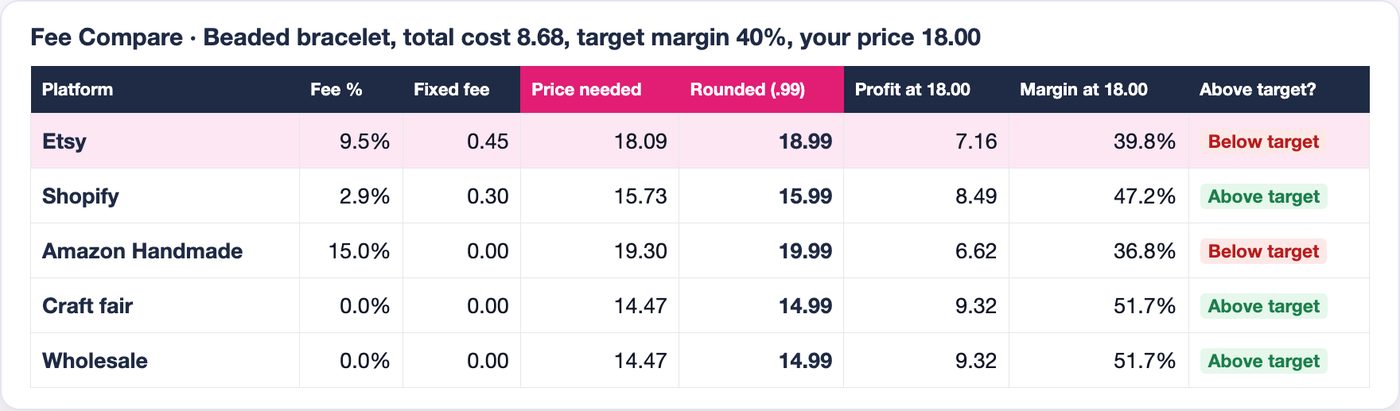
The bracelet is the clearest case in the sample: it misses the 40% target on Etsy by 0.2 points, and one dollar more, 18.99, fixes it. Fee rates live in one table on Settings, so when a platform changes its fees you edit one cell and every price follows.
Break-even: how many you need to sell
Profit per unit only matters once your fixed monthly costs are covered. The sample file uses 350 a month for rent, subscriptions and insurance. The Break-even tab divides that by the profit per unit and rounds up:
=IF(D6<=0,"n/a",ROUND(E6/D6+0.4999,0))
For the candle, 350 / 9.97 = 35.1, so 36 candles a month, or 863.64 of revenue at 23.99. The sample logs 40 sold a month, which leaves 48.81 after fixed costs (40 x 9.97 minus 350). If the sales for a product will not reach its break-even number, the price, the cost or the plan has to change.
The Dashboard: which prices to fix first
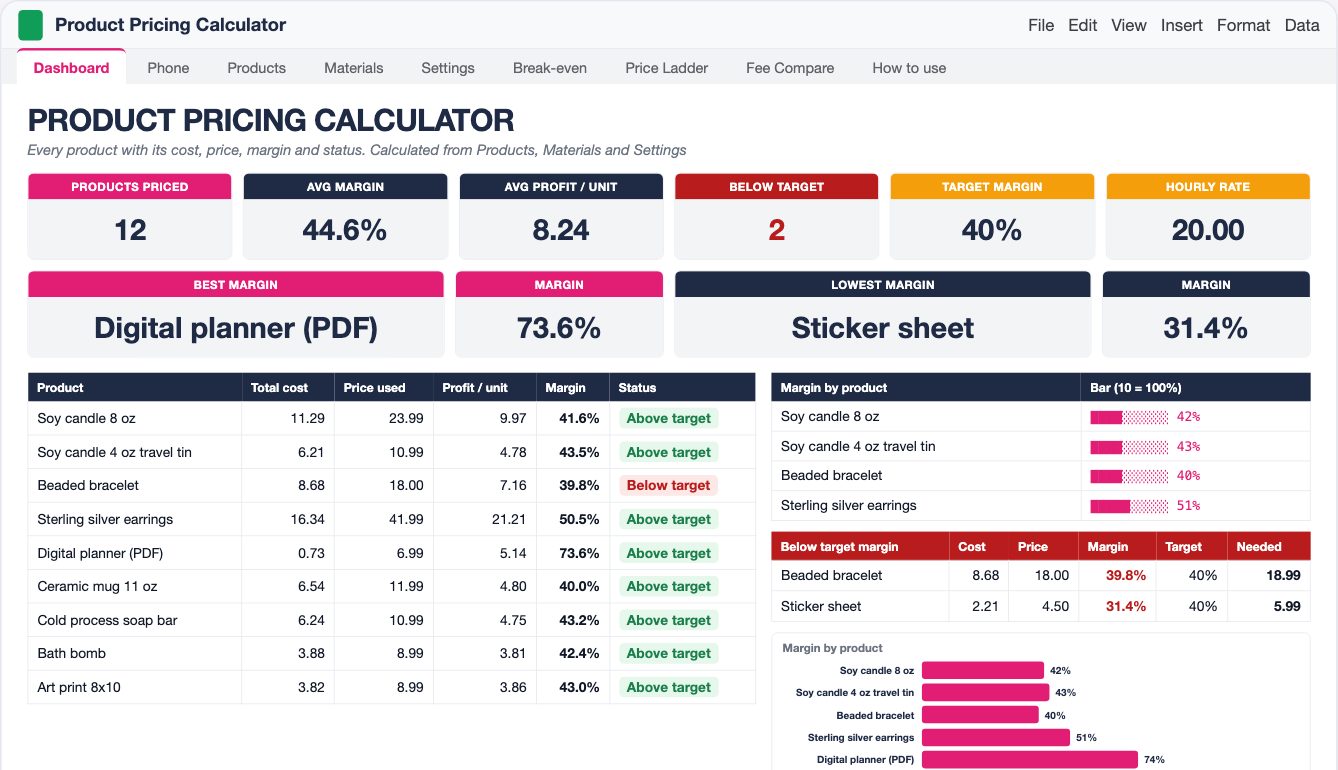
With 12 sample products priced, the Dashboard shows an average margin of 44.6% and 8.24 of profit per unit. Two products are below the 40% target, each with the price it needs: the beaded bracelet at 18.00 (needs 18.99) and the sticker sheet at 4.50 (31.4%, needs 5.99). The digital planner has the best margin at 73.6% because it has almost no materials.
Once the prices are set, keep track of what actually comes in and goes out: Side Hustle Bookkeeping: profit and loss in one tab shows a monthly P&L built from the same kind of rows. For bakers who price by the serving, Home Bakery Pricing works through a cake quote.
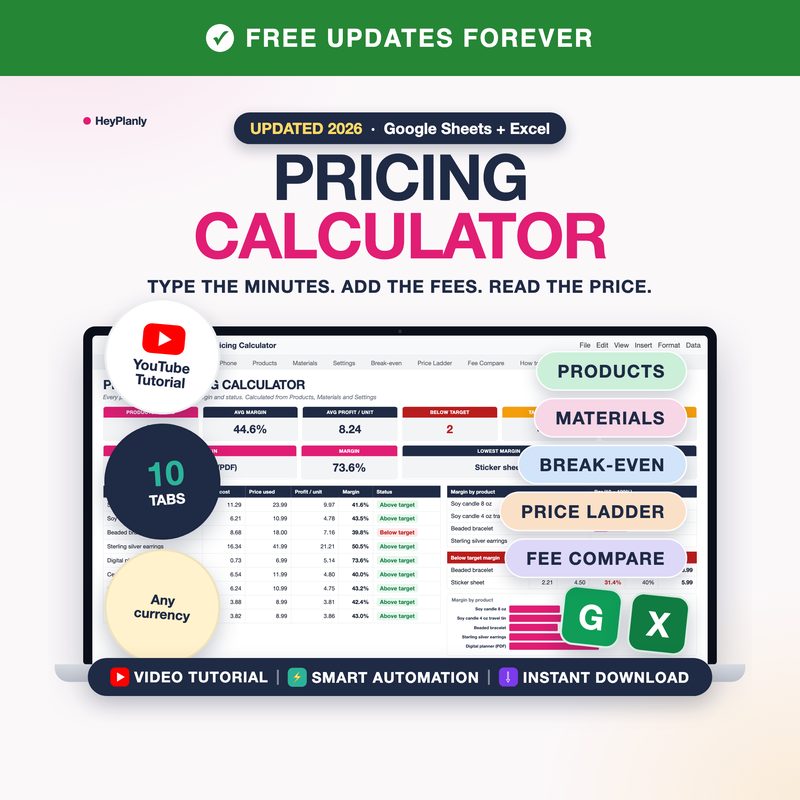
Product Pricing Calculator Spreadsheet for Google Sheets and Excel
Materials, labor, packaging, overhead and platform fees in, a suggested price, a rounded .99 price, a wholesale price, profit and margin out. Price Ladder from 20% to 70%, Fee Compare for Etsy, Shopify, Amazon Handmade and more, Break-even and a Dashboard. 12 sample products plus a blank copy.
Get the Pricing Calculator on Etsy →FAQ
What is the formula for pricing a handmade product?
Price = (total cost + fixed fee per sale) / (1 - target margin - fee %). Total cost is materials plus labor plus packaging plus overhead. For the sample 8 oz soy candle that is (11.29 + 0.45) / (1 - 0.40 - 0.095), which is 23.25, rounded up to 23.99.
Why not just double or triple my material cost?
A multiplier ignores your time and the platform's cut. The sample candle has 5.41 of materials but 11.29 of total cost once 12 minutes of labor, packaging and overhead are added. Tripling the materials would give 16.24, which leaves about 2.96 of profit after Etsy fees instead of the 9.97 at 23.99.
How much should I pay myself per hour in my pricing?
Pick a rate and put it in the cost, so the price pays for it. The sample file uses 20.00 an hour. For the candle, every 5.00 change in the hourly rate moves the total cost by 1.10 and the rounded price by 2.00 to 3.00, from 18.99 at 10.00 an hour to 31.99 at 40.00.
Do platform fees change the price I need?
Yes, because a percentage fee is taken from the selling price. For the sample beaded bracelet with a total cost of 8.68 and a 40% target, the rounded price is 18.99 on Etsy, 15.99 on Shopify, 19.99 on Amazon Handmade and 14.99 at a craft fair. Fee rates in the file are editable on the Settings tab.
Does this pricing calculator work in Excel and Google Sheets?
Yes. It is an .xlsx file that opens in Excel 2016 and later and in Google Sheets, with 10 tabs: Dashboard, Phone, Products, Materials, Settings, Break-even, Price Ladder, Fee Compare, How to use and Lists. It comes with 12 sample products and a blank copy.
More from the blog
- Home Bakery Pricing: Cost Per Serving, Cake Quotes and Your MarginHow a home bakery spreadsheet prices a cake by servings: 36 servings at 7.50 each, 342.38 with tax, a 50% deposit, and 173.67 of profit on a 149.33 cost, plus a bake plan built from confirmed orders.
- Side Hustle Bookkeeping: Profit and Loss in One TabHow a small business bookkeeping spreadsheet turns 35 income rows and 40 expenses into a monthly profit and loss: 12758.50 in, 4405.39 out, 8353.11 profit, a 65.5% margin and a quarterly tax set-aside.
- Subscription Tracker: What Your Subscriptions Cost Per YearWhat a subscription tracker spreadsheet shows for a list of 24 subscriptions: 310.32 a month and 3,723.87 a year once yearly, quarterly and weekly plans are normalized, 6 charges due in the next 7 days, a trial ending, and 5 unused subscriptions worth 875.63 a year.
- College Application Tracker: Deadlines, Fees and Essays Before 1 NovemberWhat a college application tracker spreadsheet shows five weeks before the first deadline: 10 colleges, 2 applications submitted, 415 in fees to pay, 2 of 9 essays done, 19 scholarships worth 83,250, and the real price of each college after aid, from 20,900 to 47,200 a year.