 HeyPlanly
Wedding Budget Breakdown: What Each Category Costs, in Percent
"How much should a wedding cost" has no useful answer. "How much of our budget should go to each category" does. Below is a full breakdown on the sample wedding from a budget tracker: 30,000 for 120 guests, 60 cost lines in 12 categories, the default percentage for each one, what the couple actually planned, and the three formulas that turn a list of quotes into a split you can steer.
The default split, turned into money
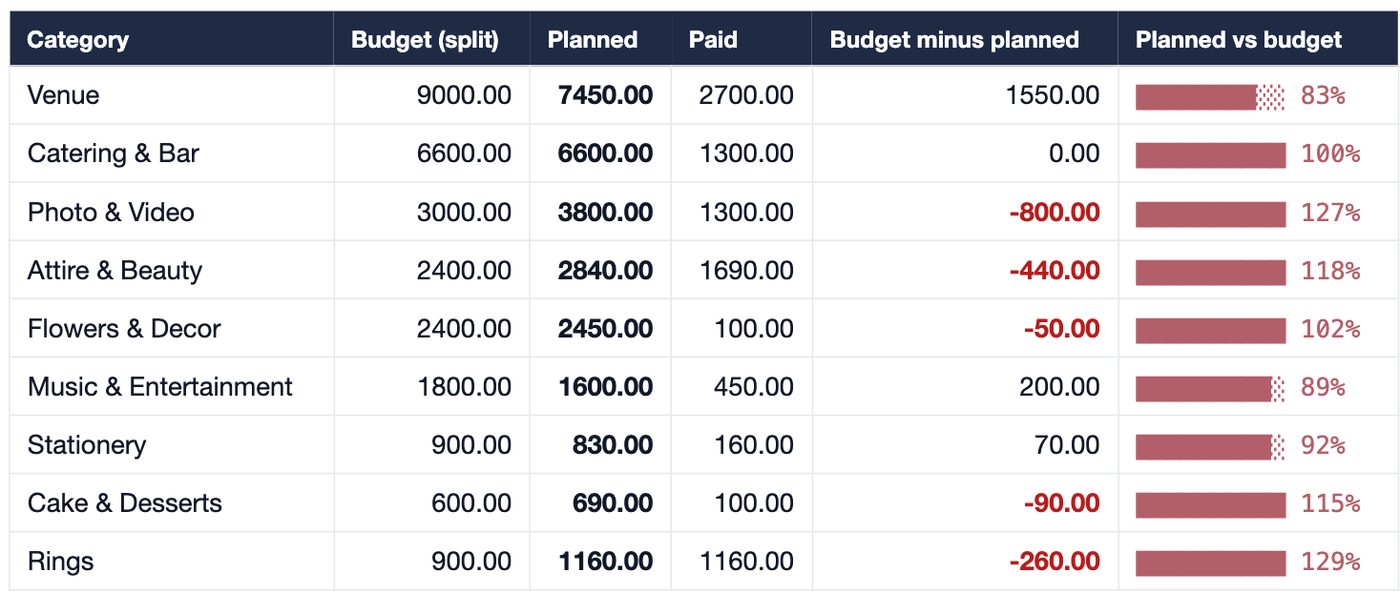
The template keeps the percentages on its Lists tab, so you can change them; they must add up to 100%. On a 30,000 budget they give these targets, next to what the sample couple planned from their estimates, quotes and final invoices:
| Category | Default % | Target | Planned | Planned % | Difference | Flag |
|---|---|---|---|---|---|---|
| Venue | 30% | 9,000 | 7,450 | 24.8% | -1,550 | Under |
| Catering & Bar | 22% | 6,600 | 6,600 | 22.0% | 0 | On track |
| Photo & Video | 10% | 3,000 | 3,800 | 12.7% | +800 | Over |
| Attire & Beauty | 8% | 2,400 | 2,840 | 9.5% | +440 | Over |
| Flowers & Decor | 8% | 2,400 | 2,450 | 8.2% | +50 | On track |
| Music & Entertainment | 6% | 1,800 | 1,600 | 5.3% | -200 | Under |
| Other | 4% | 1,200 | 1,860 | 6.2% | +660 | Over |
| Stationery | 3% | 900 | 830 | 2.8% | -70 | On track |
| Rings | 3% | 900 | 1,160 | 3.9% | +260 | Over |
| Cake & Desserts | 2% | 600 | 690 | 2.3% | +90 | On track |
| Transportation | 2% | 600 | 720 | 2.4% | +120 | On track |
| Favors & Gifts | 2% | 600 | 754 | 2.5% | +154 | Over |
| Total | 100% | 30,000 | 30,754 | 102.5% | +754 |
Two things stand out. The venue and the food together are 14,050, 47% of the budget, and they are the two lines the couple got right or better. And the overage is not one bad decision: it is five categories that each drifted by a few hundred.
Where the 754 came from
It started before any quote arrived. The 60 estimates on the Budget tab already add up to 30,500, so the plan was 500 over on day one. Quotes and final invoices then moved 24 lines, some up and some down, for another +254: venue rental 5,800 → 6,000, dinner for 120 guests 3,840 → 3,960, photographer 2,100 → 2,200, and in the other direction tables and linens 500 → 400, videographer 1,000 → 900.
The category that surprises people is Other: 10 small lines, 1,860 in total, 6.2% of the budget against a 4% default. Rehearsal dinner 500, officiant 400, vendor tips in cash 400, wedding insurance 150, dance lessons 100, guest book and signage 90, getting-ready snacks 80, marriage license 60, emergency kit 50, website domain 30. None of them is big; all of them are real, and most couples do not write them down until the week they are due.
Formula 1: planned cost per category
Every cost line has a category from a dropdown and a Planned cost that takes the final invoice if there is one, else the quote, else the estimate. One SUMIF per category adds them up, and the target is just the percentage times the budget:
Planned cost:  =SUMIF(Budget!$B$6:$B$125, B8, Budget!$H$6:$H$125)
Target:        =C8 * $C$5                 (default % × total budget)
Difference:    =E8 - D8                   (planned minus target)
For Photo & Video that is 2,200 + 900 + 400 + 300 = 3,800 planned against 10% × 30,000 = 3,000, a difference of +800.
Formula 2: a flag that ignores noise
A category 50 over its target is not a problem; one 800 over is. The flag uses a tolerance of 5% of the target, but never less than 0.5% of the whole budget (150 here), so small categories do not turn red over a few dollars:
=IF(ABS(G8) <= MAX(0.05*D8, 0.005*$C$5), "On track", IF(G8 > 0, "Over", "Under"))
That is why Transportation, 120 over a 600 target, is still On track, and Favors & Gifts, 154 over the same 600 target, is Over: the line is at 150. Flowers at +50 and Cake at +90 stay green too.
Formula 3: how many guests the budget covers
Only some costs grow with the guest count. On the Lists tab three categories are marked as per guest: Catering & Bar (6,600), Cake & Desserts (690) and Favors & Gifts (754). Together that is 8,044, or 67.03 per guest at 120 guests. Everything else, 22,710, is fixed: the venue, the photographer and the dress cost the same for 100 guests or 140.
Per-guest costs:   =SUMIF(D8:D27, "Yes", C8:C27)               → 8,044
Cost per guest:    =J8 / C5                                     → 67.03
Guests it covers:  =ROUNDDOWN((J12 - J9) / J10, 0)              → 108
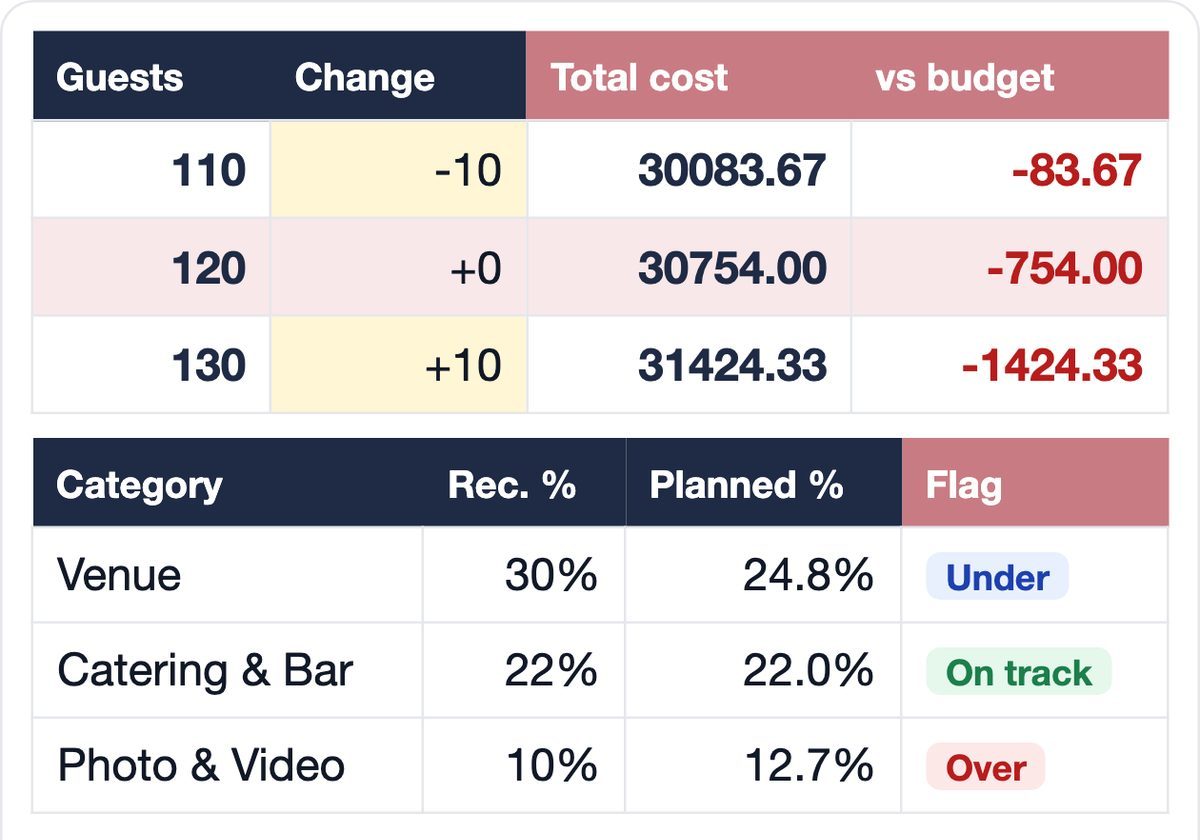
(30,000 - 22,710) / 67.03 = 108.75, so the budget covers 108 guests with the current plan. The what-if table shows the same from the other side:
| Guests | Per-guest costs | Fixed costs | Total | vs 30,000 |
|---|---|---|---|---|
| 100 | 6,703.33 | 22,710 | 29,413.33 | +586.67 |
| 110 | 7,373.67 | 22,710 | 30,083.67 | -83.67 |
| 120 | 8,044.00 | 22,710 | 30,754.00 | -754.00 |
| 130 | 8,714.33 | 22,710 | 31,424.33 | -1,424.33 |
| 140 | 9,384.67 | 22,710 | 32,094.67 | -2,094.67 |
This is the useful part of the breakdown: every 10 guests move the total by 670.33. Cutting the guest list is one lever; cutting 754 of fixed costs (for example, the 800 Photo & Video overage) is another, and it keeps all 120 people.
Reading the split without panicking
The couple in the sample has paid 9,372 so far, 30% of the plan, and has 21,382 still to pay. Their families pledged 30,000 in total (15,000 from the couple's savings, 10,000 and 5,000 from the two sets of parents), so the funding gap is the same 754. That is a decision, not a crisis, and the split tells them where to make it:
- Accept a category that is over if another one is under. The venue freed 1,550; that is why a 2,314 overage in five categories only shows up as 754 in total.
- Look at Other first. Small lines are the easiest to trim, and the easiest to forget to add in the first place.
- Change the percentages if they do not fit your wedding. The defaults are a starting point; a backyard wedding moves venue money into rentals and flowers.
If you are also saving toward the date month by month, an annual budget for 2027 is where the wedding savings line lives next to everything else.
Skip the build
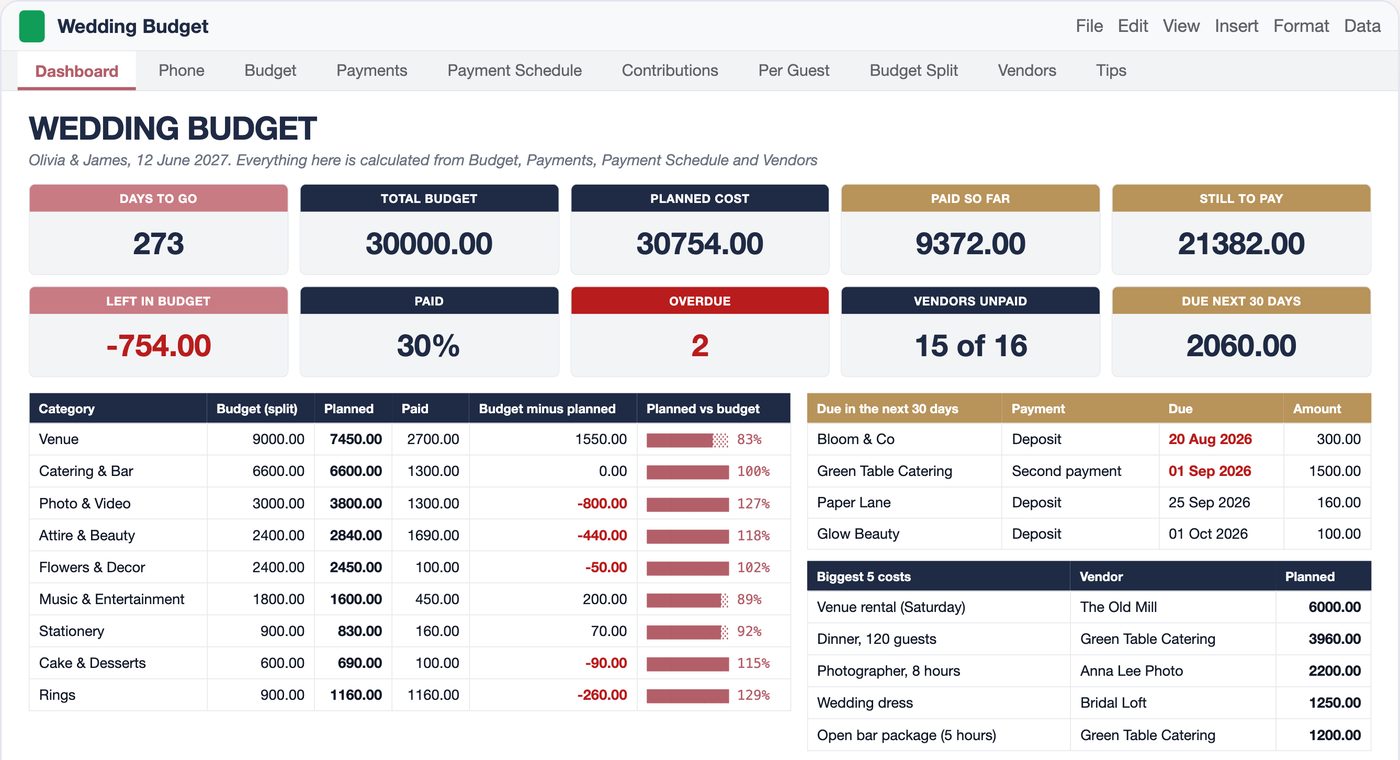
The three formulas above are the core of the Budget Split and Per Guest tabs. The tracker also logs payments against each line, flags deposits due in the next 30 days and tracks who pays what.
Wedding Budget Spreadsheet for Google Sheets and Excel
Type each cost once with its estimate, quote and final invoice, then log payments as you make them. Planned, paid, balance due and status per line, the split by category with Over / Under flags, cost per guest with a what-if, deposit due dates and contributions are calculated. Two files: Lite (4 tabs) and Full (12 tabs), sample data and blank copies.
Get the Wedding Budget Spreadsheet on Etsy →See it work
FAQ
What percentage of a wedding budget goes to the venue?
The default split in this template gives the venue 30% and catering and bar 22%, so together a little over half of the budget. In the sample wedding the venue came in at 7,450 of a 30,000 budget, 24.8%, which is 1,550 under its share. Treat the percentages as a starting point: a backyard wedding spends less on the venue and more on rentals.
How do I split a wedding budget by category?
Multiply the total budget by each category's percentage to get a target, then add up your planned costs per category with SUMIF and compare the two. With a 30,000 budget, 10% for photo and video is 3,000; the sample couple planned 3,800, so that category is 800 over.
How do I know how many guests I can afford?
Split costs into ones that grow with the guest count (food, bar, cake, favors) and fixed ones (everything else). In the sample, per-guest costs are 8,044 for 120 guests, 67.03 each, and fixed costs are 22,710. (30,000 - 22,710) / 67.03 = 108.75, so the budget covers 108 guests.
Why do wedding budgets go over?
In the sample it is not one big item. The estimates alone added up to 30,500, already 500 over a 30,000 budget, and quotes added another 254. The overage is spread across photo and video (+800), the Other category (+660), attire and beauty (+440), rings (+260) and favors (+154); the venue coming in 1,550 under absorbed most of it.
What should go in the Other category of a wedding budget?
The costs that are easy to forget. In the sample it holds 10 lines worth 1,860: rehearsal dinner 500, officiant 400, vendor tips in cash 400, wedding insurance 150, dance lessons 100, guest book and signage 90, getting-ready snacks 80, marriage license 60, emergency kit 50 and a website domain 30. That is 6.2% of the budget against a 4% default.
More from the blog
- How to Price Handmade Products: Materials, Labor, Fees and ProfitA worked pricing example for handmade products: an 8 oz soy candle that costs 11.29 to make needs 23.99 on Etsy for a 40% margin after fees. Formulas, a price ladder from 20% to 70%, fee comparison and break-even.
- Home Bakery Pricing: Cost Per Serving, Cake Quotes and Your MarginHow a home bakery spreadsheet prices a cake by servings: 36 servings at 7.50 each, 342.38 with tax, a 50% deposit, and 173.67 of profit on a 149.33 cost, plus a bake plan built from confirmed orders.
- Side Hustle Bookkeeping: Profit and Loss in One TabHow a small business bookkeeping spreadsheet turns 35 income rows and 40 expenses into a monthly profit and loss: 12758.50 in, 4405.39 out, 8353.11 profit, a 65.5% margin and a quarterly tax set-aside.
- Subscription Tracker: What Your Subscriptions Cost Per YearWhat a subscription tracker spreadsheet shows for a list of 24 subscriptions: 310.32 a month and 3,723.87 a year once yearly, quarterly and weekly plans are normalized, 6 charges due in the next 7 days, a trial ending, and 5 unused subscriptions worth 875.63 a year.