 HeyPlanly
100 Envelope Challenge vs 52 Week Challenge: How Much You Save and By When
The 100 envelope challenge and the 52 week challenge look like the same idea: a grid of boxes, one deposit per box, tick it off. They are not the same size. One adds up to 5,050, the other to 1,378, and the pace each one asks for is very different from what the name suggests. Here are both, calculated, with the printable pages and the formulas to track them.
The totals, side by side
Every one of these challenges is a ladder: the next box is the previous one plus a fixed step. The total of a ladder from 1 to n is n × (n + 1) / 2, which is why 100 envelopes give 5,050 and 52 weeks give 1,378. Here are the versions in the 100 envelope file and the classic pages of the savings challenge bundle, with the pace each would need to finish in one year.
| Challenge | Deposits | Smallest / largest | Total | Per week, 1 year |
|---|---|---|---|---|
| 100 Envelope | 100 | 1 / 100 | 5,050 | 97.12 |
| 100 Envelope Half | 100 | 0.50 / 50 | 2,525 | 48.56 |
| 100 Envelope Double | 100 | 2 / 200 | 10,100 | 194.23 |
| 50 Envelope | 50 | 1 / 50 | 1,275 | 24.52 |
| 52 Week (and Reversed) | 52 | 1 / 52 | 1,378 | 26.50 |
| Couples 52 Week | 52 | 2 / 104 | 2,756 | 53.00 |
| 26 Biweekly Paycheck | 26 | 20 / 145 | 2,145 | 41.25 |
| 365 Day Penny | 365 | 0.01 / 3.65 | 667.95 | 12.85 |
The gap is the first thing to notice. The 100 envelope challenge is 3.7 times the 52 week challenge. If a 52 week page felt easy last year, the jump to 100 envelopes is not "a bit more", it is almost four times the money. The half version (2,525) or the couples 52 week (2,756) sit in between.
In Google Sheets you can check any of these totals with one formula instead of adding boxes:
100 Envelope:   =SUM(SEQUENCE(100))          → 5050
52 Week:        =SUM(SEQUENCE(52))           → 1378
365 Day Penny:  =SUM(SEQUENCE(365))/100      → 667.95
100 envelopes: the pace is yours, the amounts are not
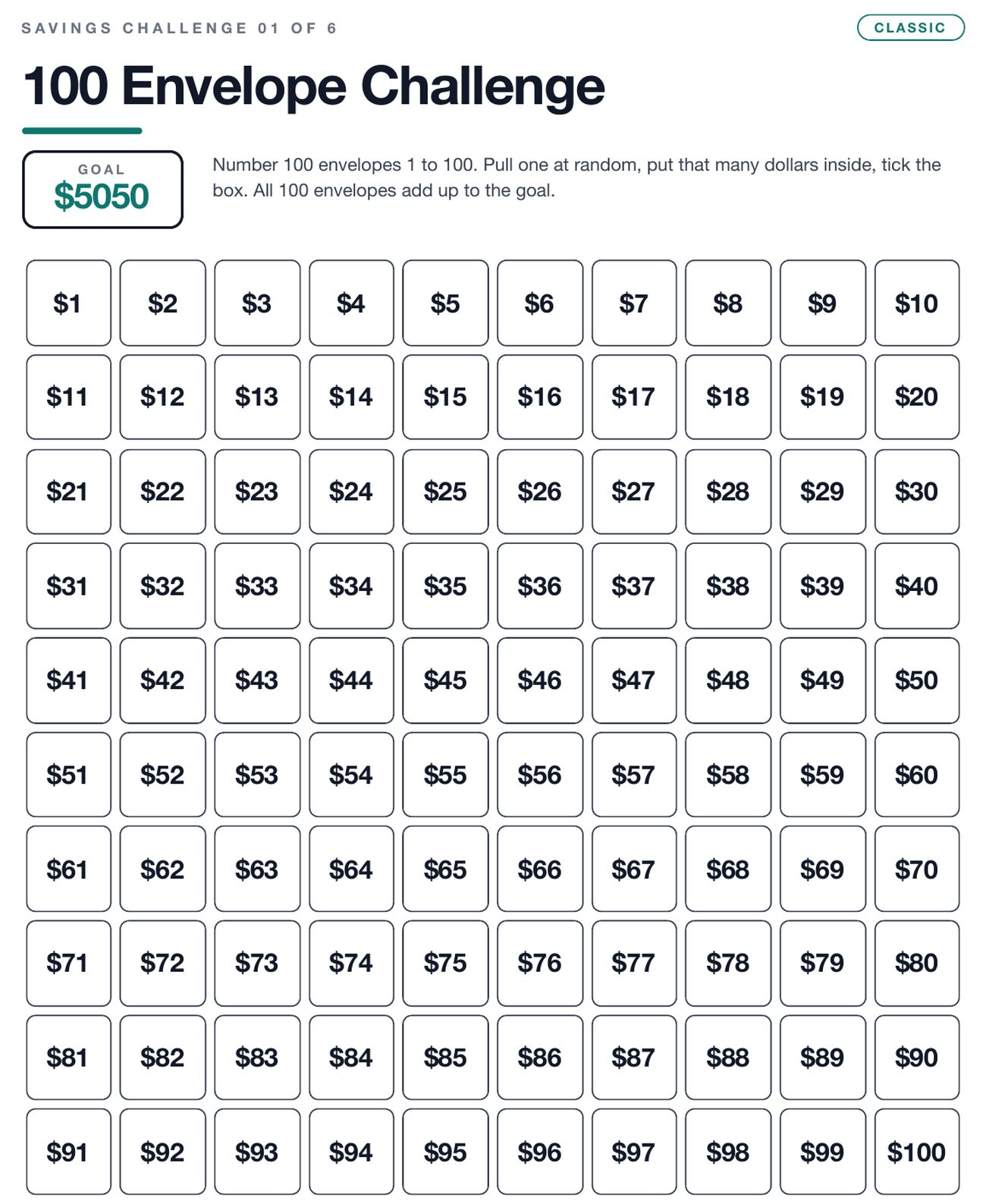
The rule is simple: number 100 envelopes, pull one at random, put that many dollars inside, tick the box. There is no calendar, so the finish date is set by how many envelopes you fill per week:
| Pace | Time to finish | Average per week |
|---|---|---|
| 1 envelope a day | 100 days | 353.50 |
| 3 envelopes a week | 34 weeks | 151.50 |
| 2 envelopes a week | 50 weeks | 101.00 |
| Finish in 1 year | 52 weeks | 97.12 |
| 1 envelope a week | 100 weeks | 50.50 |
One a day, started on January 1, 2027, ends on April 10. That is the version that circulates as "save 5,050 in 100 days", and it means about 1,500 a month. For most budgets the honest version is two a week.
The random draw is the part people underestimate. An envelope averages 50.50, so ten envelopes average 505. But ten draws can be anything from 55 (envelopes 1 to 10) to 955 (91 to 100). A run of big envelopes in the same month as rent or a car repair is normal, not bad luck. The fix is allowed by the rules: pull, and if the number does not fit this week, put it back and pull again. The total does not change, only the order.
To track it on screen, put the amounts 1 to 100 in A2:A101 and a checkbox in B2:B101. Then:
Saved so far:       =SUMIFS(A2:A101, B2:B101, TRUE)
Envelopes left:     =COUNTIFS(B2:B101, FALSE)
Weeks left at C1 a week:  =ROUNDUP(COUNTIFS(B2:B101, FALSE) / C1)
52 weeks: small start, heavy finish
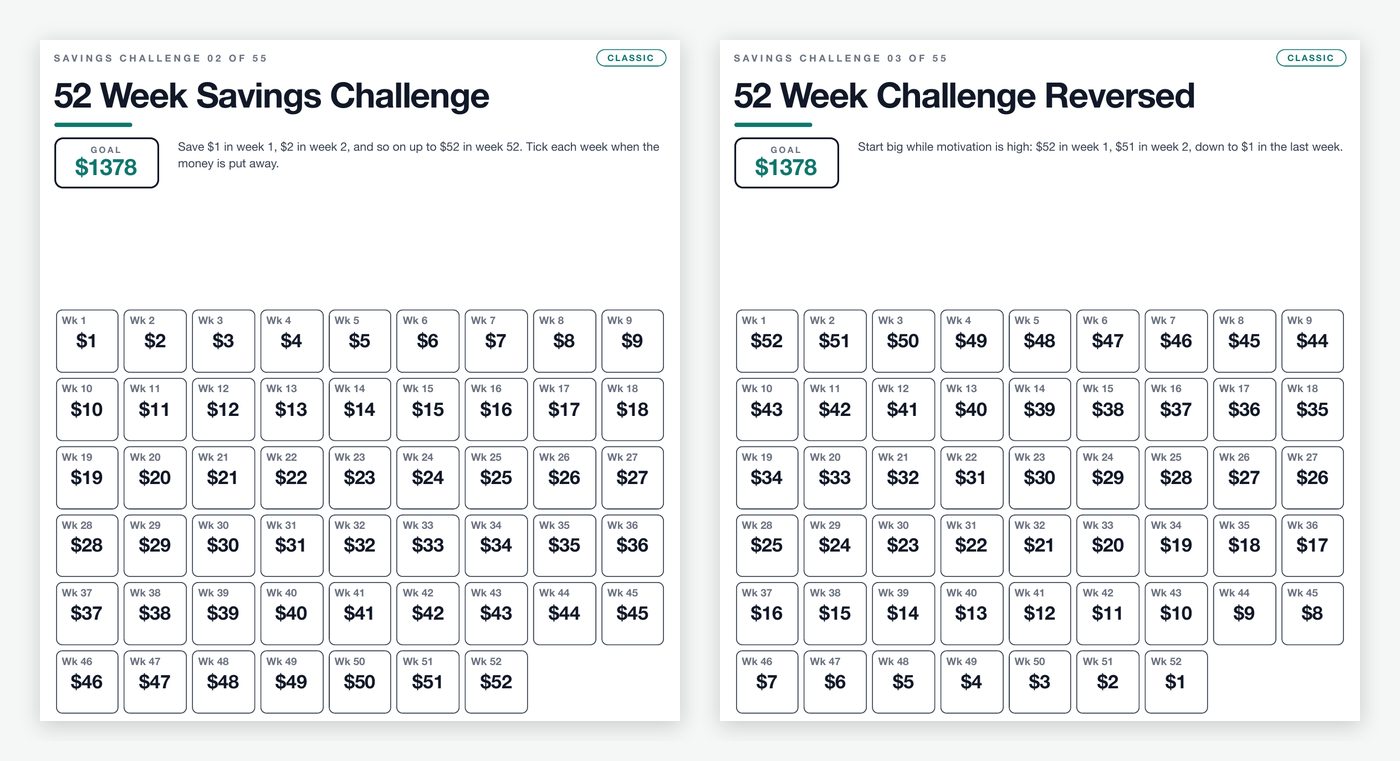
The 52 week challenge has a fixed calendar: the week number is the deposit. That makes it easy to start (week 1 is one dollar) and easy to drop, because the average hides the shape. Split the year into quarters:
| Weeks | 52 Week | Share | Reversed |
|---|---|---|---|
| 1 to 13 | 91 | 7% | 598 |
| 14 to 26 | 260 | 19% | 429 |
| 27 to 39 | 429 | 31% | 260 |
| 40 to 52 | 598 | 43% | 91 |
| Total | 1,378 | 100% | 1,378 |
At the halfway point, week 26, the classic plan has 351 saved: a quarter of the goal after half the year. Started on Monday January 4, 2027, week 52 falls on December 27, and the last four weeks alone ask for 49 + 50 + 51 + 52 = 202, exactly when gifts and food are due. If that sounds familiar, the Christmas budget article shows what December already has to carry.
The reversed page flips the order: 52 in week 1, 1 in week 52. Same total, but 598 is saved in the first quarter and December asks for 10. If you want to know in which week a running goal is reached, the cumulative total after week n is n × (n + 1) / 2, and the inverse gives the week:
Saved after week n (C1 = n):      =C1*(C1+1)/2
Week you reach a target (C1 = 1000): =ROUNDUP((SQRT(1+8*C1)-1)/2)   → 45
So a 1,000 emergency cushion inside the classic 52 week plan arrives in week 45 (1,035 saved), not "around the middle of the year".
Which one to pick
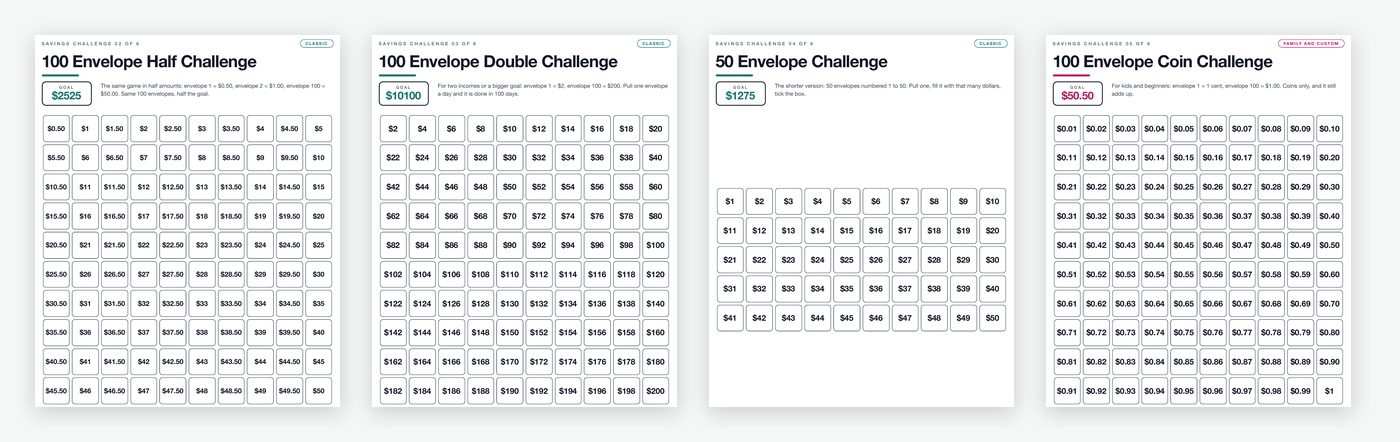
- First savings habit, tight budget: 52 week or the 50 envelope version (1,275). Both are under 27 a week on average.
- A real goal around 5,000 (an emergency fund, a car, a wedding deposit): 100 envelopes at two a week.
- Paid every two weeks: the 26 biweekly paycheck challenge (20 on the first payday, plus 5 each time, 145 on the last, 2,145 total) matches your cash flow better than weekly boxes. The biweekly paycheck budget article shows how to find room for it.
- Two incomes: the double envelope (10,100) or the couples 52 week (2,756).
- Kids: the coin version, 1 cent to 1 dollar, adds up to 50.50.
- Holiday season is your tight month: the reversed 52 week.
Whichever you pick, write the start date on the page. A challenge with a start date has a finish date you can check; one without it just stays half ticked on the fridge.
Skip the math
Every number above is on a printable page with the goal already added up in the header, one box per deposit, and Started / Finished / Saved so far lines at the bottom.
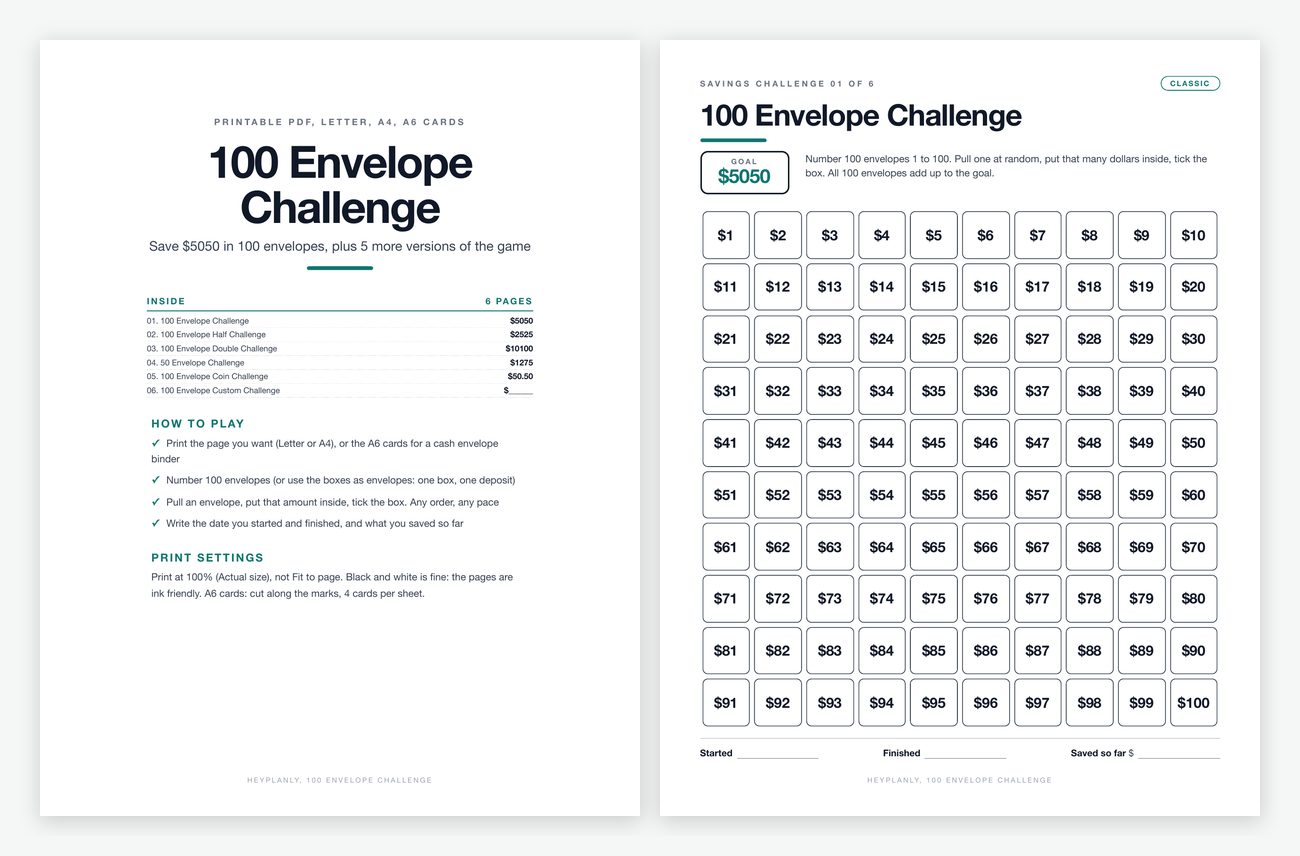
100 Envelope Challenge Printable, 6 Versions
Classic 5,050, Half 2,525, Double 10,100, 50 Envelope 1,275, Coin 50.50 and a blank custom page for any currency. US Letter and A4 PDFs plus A6 cards with cut marks, ink friendly, print as many copies as you like.
Get the 100 Envelope Challenge on Etsy →If you want the 52 week, the reversed 52 week, the 26 biweekly, the 365 day penny and 51 more in one file, the Savings Challenge Printable Bundle has 55 challenges in Letter, A4, A5 and A6 sizes.
FAQ
How much do you save with the 100 envelope challenge?
5,050 dollars. The envelopes are numbered 1 to 100 and each one holds its number in dollars, so the total is 1 + 2 + ... + 100 = 5,050. The half version (0.50 to 50) adds up to 2,525, the double version (2 to 200) to 10,100, and the 50 envelope version (1 to 50) to 1,275.
How long does the 100 envelope challenge take?
It depends only on how many envelopes you fill per week. One a day finishes in 100 days (January 1 to April 10). Two a week finishes in 50 weeks. To finish in one year you need a little under two a week, about 97 dollars a week or 421 a month on average.
How much do you save with the 52 week challenge?
1,378 dollars: 1 in week 1, 2 in week 2, up to 52 in week 52. The average is 26.50 a week, but it is uneven: the first 13 weeks add up to 91 and the last 13 weeks to 598. The couples version (each partner saves the week number) doubles it to 2,756.
Is the reversed 52 week challenge better?
It saves exactly the same 1,378, just in the opposite order: 52 in week 1 down to 1 in week 52. It puts the biggest deposits at the start, while motivation is high, and the smallest in December. If your year ends with holiday spending, the reversed order is usually easier to finish.
Can I do a savings challenge in pounds or euros?
Yes. The amounts are just numbers; the totals are the same in any currency. A printable with a blank custom page lets you write your own amounts, and in a spreadsheet you only change the currency format.
More from the blog
- How to Price Handmade Products: Materials, Labor, Fees and ProfitA worked pricing example for handmade products: an 8 oz soy candle that costs 11.29 to make needs 23.99 on Etsy for a 40% margin after fees. Formulas, a price ladder from 20% to 70%, fee comparison and break-even.
- Home Bakery Pricing: Cost Per Serving, Cake Quotes and Your MarginHow a home bakery spreadsheet prices a cake by servings: 36 servings at 7.50 each, 342.38 with tax, a 50% deposit, and 173.67 of profit on a 149.33 cost, plus a bake plan built from confirmed orders.
- Side Hustle Bookkeeping: Profit and Loss in One TabHow a small business bookkeeping spreadsheet turns 35 income rows and 40 expenses into a monthly profit and loss: 12758.50 in, 4405.39 out, 8353.11 profit, a 65.5% margin and a quarterly tax set-aside.
- Subscription Tracker: What Your Subscriptions Cost Per YearWhat a subscription tracker spreadsheet shows for a list of 24 subscriptions: 310.32 a month and 3,723.87 a year once yearly, quarterly and weekly plans are normalized, 6 charges due in the next 7 days, a trial ending, and 5 unused subscriptions worth 875.63 a year.