 HeyPlanly
Couples Budget Spreadsheet: Split Bills by Income, Not 50/50
Splitting every bill down the middle feels simple until one partner earns noticeably more. Then 50/50 means the lower earner puts a much bigger part of their pay into rent and groceries, and has less left for anything personal. A proportional split fixes that with one percentage. This article walks through a sample couple in a Google Sheets couples budget, with the real numbers from the file: the shares, what each moves to the joint account and how one settle up line evens out the month.
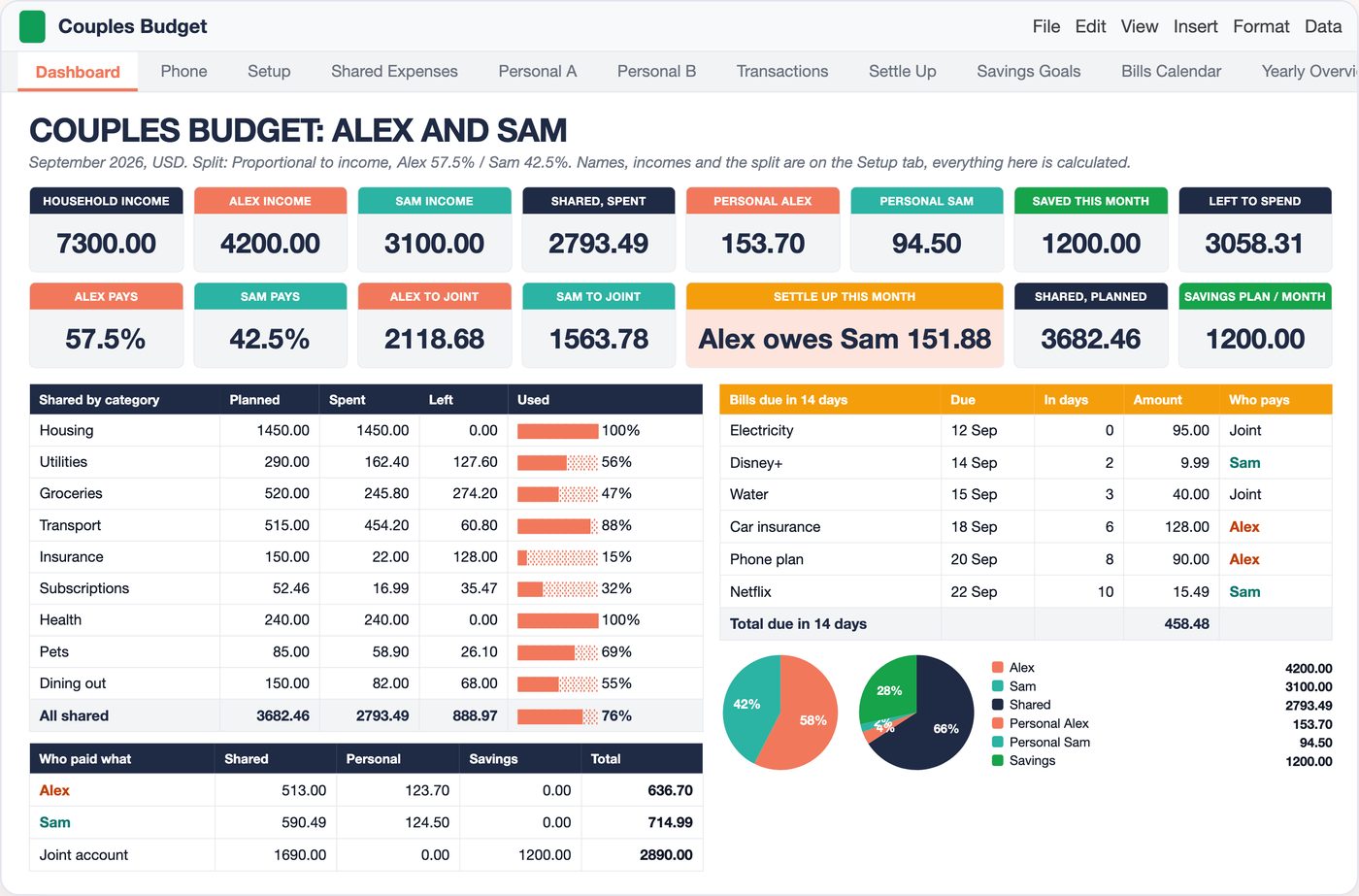
The sample couple: two incomes, one household
The file is set to September 2026, in USD. Alex takes home a salary of 3,800 plus 400 from side gigs; Sam has 2,800 of salary and 300 from tutoring. There are 22 shared lines on the Shared Expenses tab, from rent of 1,450 down to a 9.99 cloud storage plan, 3,682.46 in total. Each line has a "usually paid by": 6 come out of the joint account, the rest are paid by Alex or Sam from their own cards.
| Step | Alex | Sam | Household |
|---|---|---|---|
| Take-home income | 4,200.00 | 3,100.00 | 7,300.00 |
| Share of income | 57.5% | 42.5% | 100% |
| Shared costs planned | 3,682.46 | ||
| Share of shared costs | 2,118.68 | 1,563.78 | 3,682.46 |
| Left after shared costs | 2,081.32 | 1,536.22 | 3,617.54 |
The 2,118.68 and 1,563.78 are what each partner moves to the joint account on payday. Everything on the Dashboard is calculated from those few yellow cells on Setup.
50/50 vs proportional, in numbers
Here is the same 3,682.46 split both ways. The useful column is the last one: what part of each paycheck goes into the household.
| Split | Partner | Pays | Left | Pays as % of income |
|---|---|---|---|---|
| 50/50 | Alex | 1,841.23 | 2,358.77 | 43.8% |
| 50/50 | Sam | 1,841.23 | 1,258.77 | 59.4% |
| Proportional | Alex | 2,118.68 | 2,081.32 | 50.4% |
| Proportional | Sam | 1,563.78 | 1,536.22 | 50.4% |
At 50/50, Sam puts 59.4% of their pay into shared costs and Alex 43.8%. With the proportional split both put in the same 50.4%, because the shared total is 50.4% of household income (3,682.46 / 7,300). The difference is 277.45 a month moved from Sam's side to Alex's, or about 3,329 over a year at the same plan. Neither method is the right one for every couple; the point is to see the number before you agree on it.
The share itself is one formula. With Alex's income in B2 and Sam's in C2:
=IF(B2+C2=0, 0.5, B2/(B2+C2))
On the sample that returns 0.5753, shown as 57.5%. The IF keeps the file at 50/50 while both incomes are still empty. In the template the split method is a dropdown (50/50, proportional to income, or a custom % for partner A), so you can switch and compare in a second.
Log who paid, not just what
A split only works if every expense says who paid it. The Transactions tab has one row per payment: date, description, amount, budget line, and Paid by (Alex, Sam or Joint). If you leave the budget line empty, the Rules tab fills it from keywords in the description: "Whole Foods" becomes Groceries, "Comcast" becomes Internet.
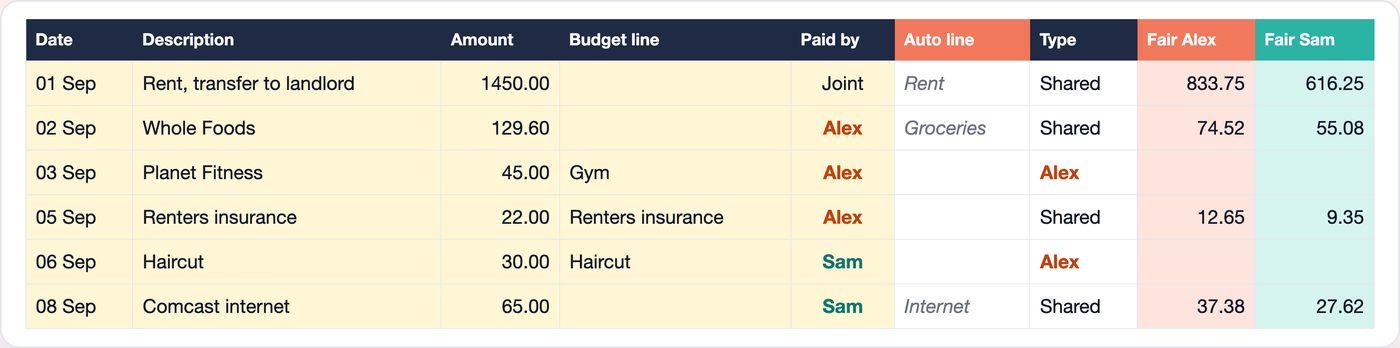
What each partner paid on shared bills in a month is a SUMIFS on three conditions: the type is Shared, the payer is Alex, the month key is 202609:
=SUMIFS(Transactions!D7:D506, Transactions!I7:I506, "Shared",
        Transactions!F7:F506, "Alex", Transactions!K7:K506, 202609)
On the sample that is 513.00 for Alex (Whole Foods 129.60, renters insurance 22, fuel 51.40, car payment 310) and 590.49 for Sam, by 12 September. The joint account has paid 1,690.00: rent and health insurance.
Settle up: one transfer a month
Joint account payments are already fair, because the account was funded in the 57.5 / 42.5 shares. So the settle up only looks at what the two of you paid from your own money: 513.00 + 590.49 = 1,103.49.
| Settle Up, September 2026 | Amount |
|---|---|
| Alex paid on shared bills | 513.00 |
| Sam paid on shared bills | 590.49 |
| Alex fair share, 57.5% of 1,103.49 | 634.88 |
| Sam fair share, 42.5% of 1,103.49 | 468.61 |
| Shared balance for Alex | -121.88 |
| Alex's haircut, paid by Sam | 30.00 |
| Net for Alex | -151.88 |
The net is paid minus fair share, plus your partner's personal costs you covered, minus yours they covered. In the template, with C7 and C8 what each paid, Setup!C29 Alex's share, C16 Alex's personal paid by Sam and C17 the reverse:
=C7 - (C7 + C8) * Setup!C29 + C17 - C16
That gives -151.88, and a text formula turns it into the line you read:
=IF(ROUND(C20,2)=0, "All square",
   IF(C20>0, "Sam owes Alex ", "Alex owes Sam ") & TEXT(ABS(C20), "0.00"))
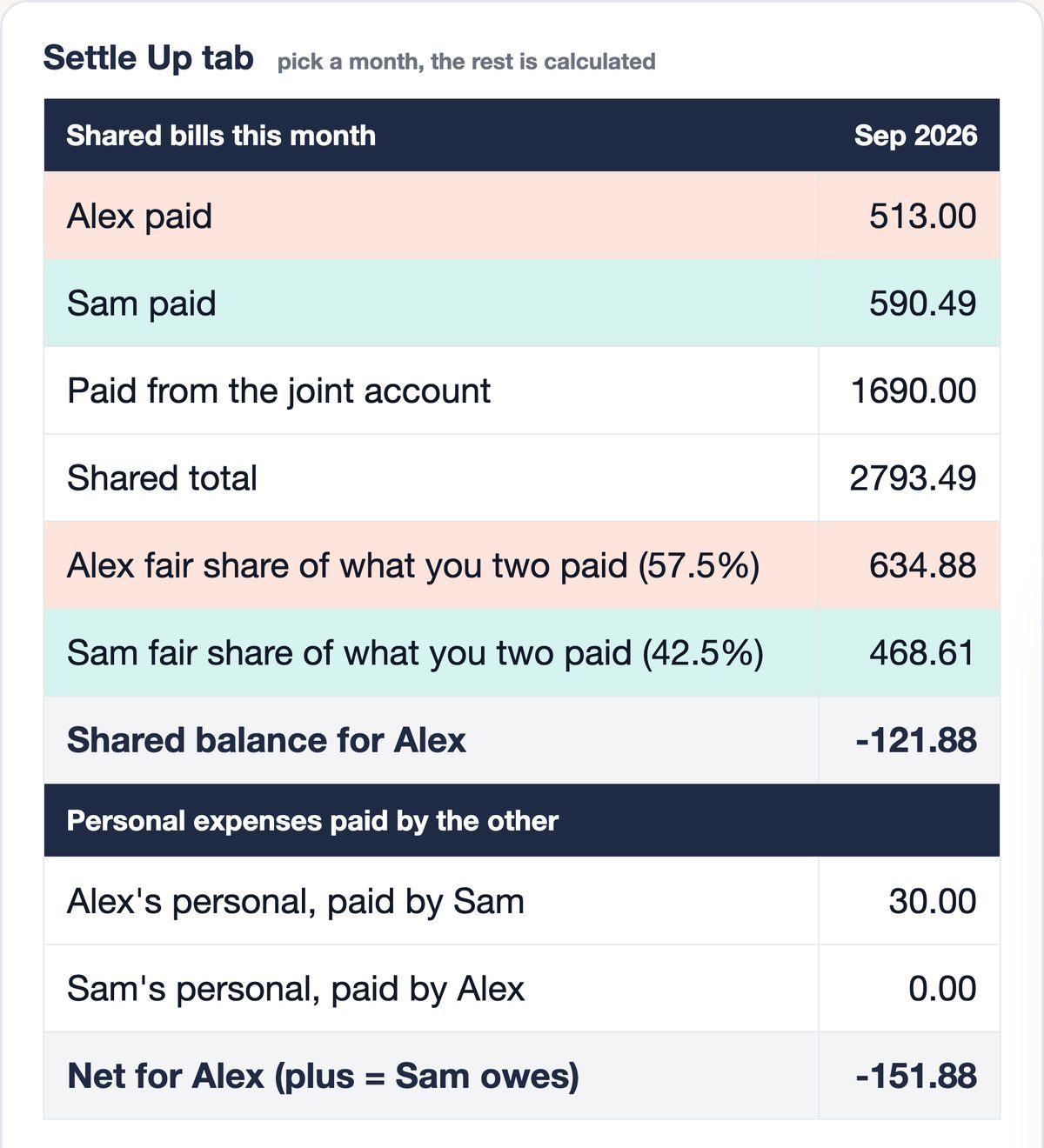
With a 50/50 split the same month would end at Alex owes Sam 68.75, so the method changes the transfer, not just the contributions. The history block keeps 12 months. In the sample July closed at Sam owes Alex 137.29 and August at Sam owes Alex 14.48: who owes whom flips from month to month, which is normal when the bigger bills land on different cards.
Savings and personal money stay separate
Each partner has a personal allowance of 350 with their own lines (gym, lunches, books) that nobody has to justify. Savings goals are funded from the joint account, 1,200 a month in the sample: Alex 675 and Sam 525 across a wedding fund, an emergency fund, a trip and a new sofa. If one of those goals is a wedding, the wedding budget breakdown shows how to plan the categories, and if you want a single-person view of where the rest of the income goes, the 50/30/20 budget is a good starting rule.
See it work
Couples and Family Budget for Google Sheets and Excel
Split shared bills 50/50, by income or by a custom %, log who paid, and get one settle up line each month. Lite (5 tabs) and Full (15 tabs) with personal allowances, savings goals, a Bills Calendar and a Phone tab. Sample data and blank copies, any currency.
Get the Couples Budget on Etsy →FAQ
How do you split bills proportionally to income?
Add both incomes, divide each income by the total, and pay that percentage of every shared bill. In the sample file Alex takes home 4,200 and Sam 3,100, so 4,200 / 7,300 = 57.5% and 42.5%. Of 3,682.46 planned shared costs, Alex covers 2,118.68 and Sam 1,563.78.
Is 50/50 or income-based splitting fairer?
It depends on what you call fair. At 50/50 both pay 1,841.23 in the sample, which is 43.8% of Alex's income and 59.4% of Sam's. With the proportional split both pay the same 50.4% of what they earn. The file lets you pick 50/50, proportional or a custom % and every line follows.
Do we need a joint account to split by income?
No. With a joint account each partner moves their share into it on payday (2,118.68 and 1,563.78 in the sample). Without one, each of you logs who paid what, and the settle up line gives the one transfer that evens the month.
What happens when one partner pays for the other's personal stuff?
It goes into the settle up too. In September Sam paid Alex's 30 haircut, so the 121.88 Alex is behind on shared bills becomes 151.88. Joint account payments stay out of the transfer because both partners already funded them in their shares.
What if one income changes during the year?
Type the new income on the Setup tab. The shares, the joint account contributions and the settle up for the month you pick are recalculated from the current Setup, so a raise or a month of reduced hours changes the split from that point.
More from the blog
- How to Price Handmade Products: Materials, Labor, Fees and ProfitA worked pricing example for handmade products: an 8 oz soy candle that costs 11.29 to make needs 23.99 on Etsy for a 40% margin after fees. Formulas, a price ladder from 20% to 70%, fee comparison and break-even.
- Home Bakery Pricing: Cost Per Serving, Cake Quotes and Your MarginHow a home bakery spreadsheet prices a cake by servings: 36 servings at 7.50 each, 342.38 with tax, a 50% deposit, and 173.67 of profit on a 149.33 cost, plus a bake plan built from confirmed orders.
- Side Hustle Bookkeeping: Profit and Loss in One TabHow a small business bookkeeping spreadsheet turns 35 income rows and 40 expenses into a monthly profit and loss: 12758.50 in, 4405.39 out, 8353.11 profit, a 65.5% margin and a quarterly tax set-aside.
- Subscription Tracker: What Your Subscriptions Cost Per YearWhat a subscription tracker spreadsheet shows for a list of 24 subscriptions: 310.32 a month and 3,723.87 a year once yearly, quarterly and weekly plans are normalized, 6 charges due in the next 7 days, a trial ending, and 5 unused subscriptions worth 875.63 a year.