 HeyPlanly
Credit Card Payoff: Minimum Payment vs Fixed Payment, Month by Month
A credit card minimum payment is designed to keep the account current, not to pay the card off. The difference between the minimum and a fixed amount you choose is not a few months; on the sample card below it is 30 months and 878.40 of interest. Here is the month-by-month math on real numbers from a payoff tracker, and the one formula that shows it for your own cards.
=NPER(APR/12, -payment, balance).The sample: five cards, 7,240.09
The numbers come from the sample data in the Credit Card Payoff Tracker: five cards, 40 logged payments, purchases, interest charges and fees from June to September 2026, and the balances they produce on September 15.
| Card | Balance | Limit | APR | Minimum | Paid in Sept |
|---|---|---|---|---|---|
| Chase Visa | 2,427.94 | 5,000 | 24.99% | 95 | 400 |
| Amex Blue Cash | 2,095.80 | 8,000 | 21.99% | 70 | 0 (due 18 Sep) |
| Capital One | 1,377.65 | 3,000 | 27.49% | 60 | 200 |
| Discover it (0% promo) | 848.75 | 2,500 | 0% | 35 | 100 |
| Target card | 489.95 | 1,000 | 29.99% | 29 | 120 |
| Total | 7,240.09 | 19,500 | 289 | 820 |

Two numbers on that dashboard are the reason this article exists. Interest and fees since June: 599.05. Interest expected this month alone, at balance × APR / 12 per card: 132.77. The minimums add up to 289, so if this household paid only the minimums, almost half of every payment would go to interest before it touched a balance.
One card, month by month
Take the Chase Visa: 2,427.94 at 24.99%. The first month's interest is 2,427.94 × 24.99% / 12 = 50.56. A 95 payment leaves 44.44 for the balance. A 400 payment leaves 349.44, almost eight times as much, for four times the payment. That is the whole mechanism: interest takes its cut first, and everything above it is what actually pays the card off.
| Fixed monthly payment | Months to zero | Interest paid | Total paid |
|---|---|---|---|
| 95 (the minimum) | 37 | 1,074.09 | 3,502.03 |
| 150 | 20 | 564.00 | 2,991.94 |
| 200 | 15 | 400.23 | 2,828.17 |
| 300 | 9 | 258.68 | 2,686.62 |
| 400 (what the sample pays) | 7 | 195.69 | 2,623.63 |
Going from 95 to 150, just 55 more a month, cuts 17 months and 510.09 of interest. The first step up from the minimum is the one that pays most; after 300 the curve flattens. The table assumes no new purchases on the card and the same APR the whole time, and it keeps the payment fixed. A real card's minimum is usually recalculated from the balance each month, so it gets smaller as you pay, and minimum-only payoff takes even longer than the 37 months above.
You do not need a month-by-month schedule to get the first column. NPER does it in one cell:
Months to zero:   =ROUNDUP(NPER(24.99%/12, -95, 2427.94), 0)     → 37
Interest (approx): =NPER(24.99%/12, -95, 2427.94) * 95 - 2427.94   → 1074.00
First month split: =2427.94 * 24.99%/12                          → 50.56 interest
The interest line is an approximation (the real schedule rounds each month to the cent), but it lands within a dollar of the month-by-month total of 1,074.09.
Five cards: minimums vs one fixed amount
With several cards the question changes from "how much on this card" to "how much in total, and in what order". Three ways to pay the same 7,240.09:
| Strategy | Per month | Debt-free in | Interest |
|---|---|---|---|
| Each card at its minimum, forever | 289, then less | 44 months | 2,799.54 |
| Fixed 289, freed minimums roll to the next card | 289 | 35 months | 2,650.26 |
| Fixed 439 (minimums + 150), highest APR first | 439 | 20 months | 1,372.39 |
| Fixed 820 (the September total), highest APR first | 820 | 10 months | 650.90 |
The second row is the quiet one. It costs nothing extra per month compared with today's minimums; it only refuses to spend less when a card is paid off. When the Target card's 29 is free, it goes to the Capital One card instead of back into the budget. That alone is 9 months sooner.
The third row is what the tracker's Payoff Plan suggests with its sample settings: highest APR first, extra 150 a month. The Target card (29.99%) gets 29 + 150 = 179 and is gone in 3 months, then Capital One in month 9, Chase in month 16, and Amex and the 0% Discover card in month 20.
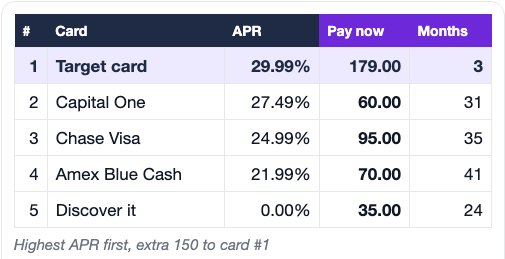
The order is a COUNTIFS rank: a card's priority is 1 plus the number of cards with a balance and a higher APR (or a smaller balance, if you switch to snowball). With the balance in column J and the APR in D of the Cards tab:
Priority (by APR):  =1 + COUNTIFS($J$6:$J$17, ">0", $D$6:$D$17, ">" & D6)
Pay this month:     =minimum + IF(priority = 1, extra, 0)
If the snowball vs avalanche choice is the part you are stuck on, this comparison on five debts runs both orders side by side. For these five cards they agree on the first target anyway: the Target card has both the highest APR and the smallest balance.
Where a fixed plan actually breaks: late payments
A payoff plan is only as good as the months you actually pay. The sample has two late statements in four months. The Target card's July payment was missed, and the log shows a 29.00 late fee on July 30, a full minimum's worth, gone. The Capital One statement due September 8 was paid on the 12th. Neither one changes the payoff math much. Both are the kind of thing that happens when due dates live in five different apps.
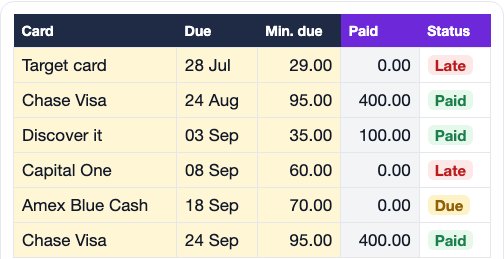
"Paid by due date" is a SUMIFS over the log between the statement date and the due date, and the flag compares it to the minimum:
Paid by due date:  =SUMIFS(Payments!E:E, Payments!C:C, B6, Payments!D:D, "Payment",
                           Payments!B:B, ">=" & C6, Payments!B:B, "<=" & F6)
Status:            =IF(G6 >= E6, "Paid", IF(TODAY() > F6, "Late", "Due"))
If your pay arrives every two weeks, line the due dates up with paydays first; the biweekly paycheck budget shows which paycheck covers which bill.
Skip the build
The formulas above are the core: balance from a log, interest per month, NPER for months to zero, a priority rank and a late flag. The tracker wires them together so you only type payments.
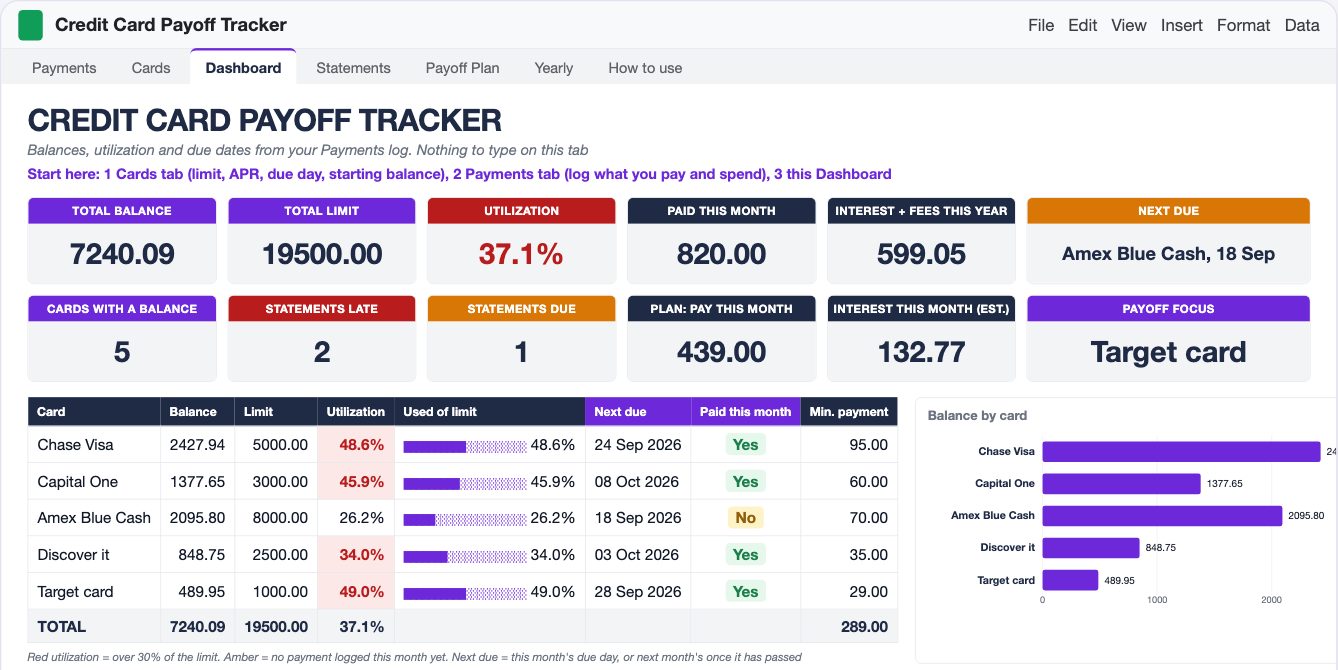
Credit Card Payoff Tracker for Google Sheets and Excel
Type each card once and log every payment, purchase, interest charge and fee. Balance now, utilization (red over 30%), next due date, paid this month, a payoff order by APR or balance with an extra per month, late statements and interest by month are calculated. Two files: Lite (4 tabs) and Full (7 tabs), sample data and blank copies.
Get the Credit Card Payoff Tracker on Etsy →See it work
FAQ
How long does it take to pay off a credit card with minimum payments?
Use NPER with the monthly rate, the payment and the balance: =NPER(24.99%/12, -95, 2427.94) gives 36.9, so 37 months. In that example 1,074.09 of the 3,502.03 you pay is interest. Real minimums usually shrink as the balance falls, which makes minimum-only payoff take even longer than this fixed-minimum estimate.
How much interest do I pay on a credit card each month?
Roughly balance × APR / 12. A 2,427.94 balance at 24.99% costs about 50.56 in the first month. With a 95 payment, only 44.44 of it reduces the balance. That split is why the minimum feels like it does nothing.
Is it better to pay a fixed amount instead of the minimum?
Yes, if the fixed amount is higher than the minimum and you keep paying it as the balance drops. In the sample, the same five cards cost 2,799.54 of interest over 44 months at their minimums, and 1,372.39 over 20 months at a fixed 439 a month (the minimums plus 150), with each paid-off card's payment moving to the next one.
Which credit card should I pay off first?
Highest APR first costs the least interest (the avalanche); smallest balance first closes cards sooner (the snowball). In the sample both start with the same card, the Target card at 29.99% with the smallest balance, 489.95, which is gone in 3 months with an extra 150 on top of its 29 minimum.
Does a 0% promo card belong in the payoff plan?
Yes, but last. At 0% the minimum goes entirely to the balance: 848.75 at 35 a month is 25 payments with no interest. Note the promo end date and make sure the balance is gone by then, because interest usually starts on whatever is left.
More from the blog
- How to Price Handmade Products: Materials, Labor, Fees and ProfitA worked pricing example for handmade products: an 8 oz soy candle that costs 11.29 to make needs 23.99 on Etsy for a 40% margin after fees. Formulas, a price ladder from 20% to 70%, fee comparison and break-even.
- Home Bakery Pricing: Cost Per Serving, Cake Quotes and Your MarginHow a home bakery spreadsheet prices a cake by servings: 36 servings at 7.50 each, 342.38 with tax, a 50% deposit, and 173.67 of profit on a 149.33 cost, plus a bake plan built from confirmed orders.
- Side Hustle Bookkeeping: Profit and Loss in One TabHow a small business bookkeeping spreadsheet turns 35 income rows and 40 expenses into a monthly profit and loss: 12758.50 in, 4405.39 out, 8353.11 profit, a 65.5% margin and a quarterly tax set-aside.
- Subscription Tracker: What Your Subscriptions Cost Per YearWhat a subscription tracker spreadsheet shows for a list of 24 subscriptions: 310.32 a month and 3,723.87 a year once yearly, quarterly and weekly plans are normalized, 6 charges due in the next 7 days, a trial ending, and 5 unused subscriptions worth 875.63 a year.