 HeyPlanly
Tax Deduction Tracker: What to Log Now So Next April Is Shorter
Most of the work of a self-employed tax return is done in April from memory and a folder of receipts. It goes faster if the year is already sorted: every expense in a category that maps to a Schedule C line, income with the platform fees taken out, miles logged as they happen. October is a good month to start, because three quarters are behind you and the fourth estimated payment is still ahead. Below is a sample year from a tax deduction tracker spreadsheet, as of 27 September 2026, with the arithmetic shown.
The sample year: a freelance designer with an Etsy shop
The sample business has 30 payments so far: 27,400 on 1099-NEC from three design clients, 5,997 on 1099-K from Etsy and Upwork, and 1,525 paid directly with no form. Against that there are 92 logged expenses, 6 recurring costs typed once, 40 business trips and a 150 sq ft home office. The rates are typed once on the Setup tab: 12% federal, 5% state, 15.3% self-employment tax.
What to log, and what each part is worth
Deductions only matter through the tax they remove, so it helps to know that rate. With the sample settings, one extra dollar of profit costs 14.13 cents of self-employment tax (15.3% on 92.35%), 11.15 cents of federal tax (12% after half of the SE tax is deducted) and 5 cents of state tax. Together that is about 30.28 cents. The same rate works in reverse for every deduction you log.
| What you log | In the sample | Deduction so far | Tax it removes, about |
|---|---|---|---|
| Expenses on Deductions | 92 rows, meals at 50%, business % applied | 7,931.36 | 2,402 |
| Recurring costs on Setup | Adobe, phone 60%, internet 50%, hosting, Canva | 1,625.91 | 492 |
| Business miles | 40 trips, 722 miles x 0.725 | 523.45 | 159 |
| Platform fees | taken out of Etsy and Upwork payouts | 635.37 | 192 |
| Home office | 150 of 1,200 sq ft, 9 months | 2,081.25 | 630 |
| Total | 12,797.34 | 3,875 |
The check on the total: with no deductions at all, profit would be 34,922 and the same three taxes would come to 9,932.42. With them, 6,057.13. The difference is 3,875.29. Note what the table leaves out: the 3,780 of health insurance (420 a month) is on Schedule 1, not Schedule C, so it lowers income tax but not profit or self-employment tax.
Two rows here are the ones people skip. Miles are easy to forget because nothing is paid at the moment, and 722 miles is only 523.45 of deduction, but it needs a log with date, place and purpose, which is hard to rebuild in April. The home office is the largest single item: the regular method (12.5% of 22,200 in rent, insurance and utilities, so 2,775 a year) beats the simplified one (150 x 5 = 750) by 2,025 a year.
Expenses: one row, three things calculated
Each expense is typed once: date, who was paid, what for, category, amount, business % and a receipt link. The sheet works out what counts, which Schedule C line it goes on, and whether the receipt is in order.
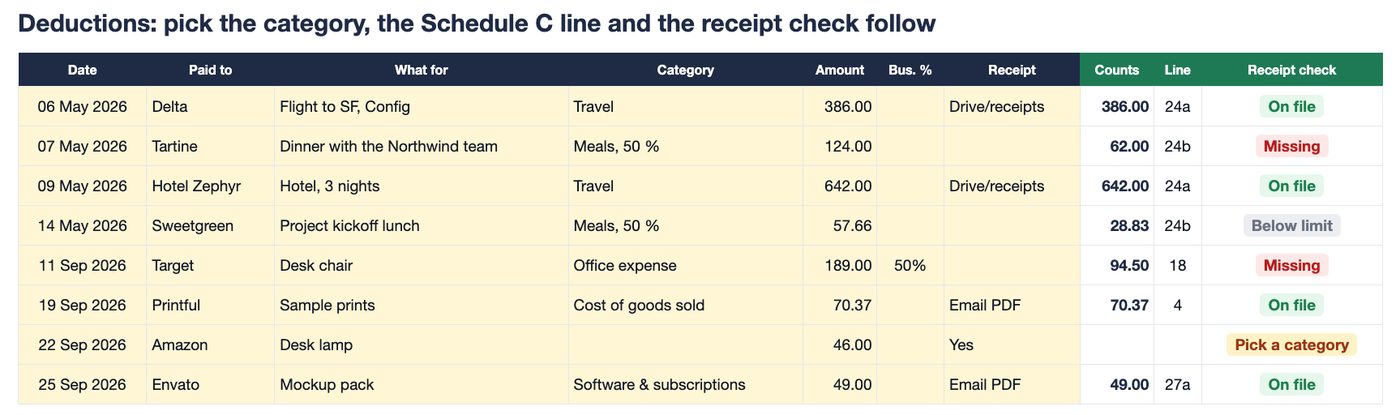
The amount that counts is amount x business % x the category's share, which is 50% for meals and 100% for most others. The line comes from a lookup on a Lists tab of 32 categories. Totals per Schedule C line are one SUMIFS each:
Line 24b, meals:  =SUMIFS(Deductions!$J$8:$J$1007, Deductions!$K$8:$K$1007, "24b",
                          Deductions!$M$8:$M$1007, 2026)
J is what counts, K the line and M the year of the date. Replace "24b" for any other line. The year condition matters once the file carries into January: rows from 2026 stay in 2026.
The receipt check: 5 to find before you file
A row is flagged Missing when there is no receipt link and the amount is at or above a limit you choose, 75 in the sample. Six rows are at least 75 with nothing in the receipt column. One of them, 164 at Costco, is in the category Personal, not deductible, so it counts 0 and is not flagged. That leaves 5: Google ads 150, a team dinner 124, a Best Buy purchase 89, Epson supplies 96 and a desk chair 189 at 50%. Together they count 491.50, roughly 149 of tax at the sample rates. A count of the raw rows:
=COUNTIFS(Deductions!$F$8:$F$1007, ">=75", Deductions!$H$8:$H$1007, "",
          Deductions!$E$8:$E$1007, "<>", Deductions!$E$8:$E$1007, "<>Personal, not deductible")
That returns 5 on the sample. Finding five receipts in October takes minutes; finding them in April means searching email for a purchase you no longer remember.
Recurring costs: type them once
Subscriptions and bills are the expenses that never get logged, because nothing about them happens on a given day. On the Setup tab each one is a single row with the monthly amount, the business % and the first month, and the sheet counts it for every month so far.

The phone plan shows why the business % sits in its own column: 85 x 60% x 9 months = 459, not 765. Canva started in March, so it is 7 x 15 = 105.
Quarterly payments: what is due on 15 January
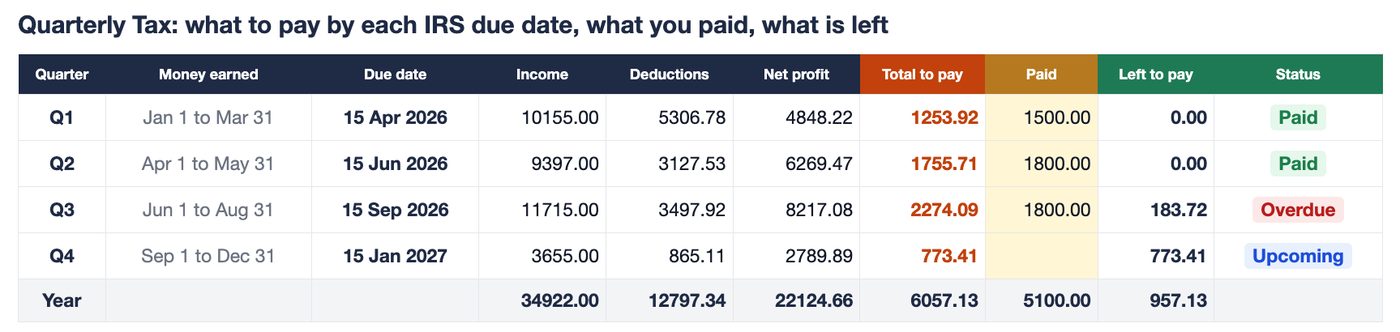
Estimated tax is not one quarter of the year's tax. The file adds up profit for the IRS periods so far, works out the tax on it, and subtracts what earlier quarters already counted. Payments carry over: Q1 was paid 1,500 against 1,253.92 and Q2 1,800 against 1,755.71, so 290.37 went in early. Q3 needed 2,274.09, received 1,800, and is short 2,274.09 - 1,800 - 290.37 = 183.72.
| Year so far, to 27 Sep | Amount | How |
|---|---|---|
| Net profit | 22,124.66 | 34,922 - 12,797.34 |
| Self-employment tax | 3,126.11 | 22,124.66 x 92.35% x 15.3% |
| Federal income tax | 2,013.79 | 12% of profit less half SE tax and 3,780 health insurance |
| State income tax | 917.23 | 5% of profit less health insurance |
| Estimated tax so far | 6,057.13 | paid 5,100.00, left 957.13 |
The Q4 figure, 773.41, is the year's 6,057.13 minus the 5,283.72 that Q1 to Q3 counted. It will grow with every payment logged before December 31. The set aside rate is the same total divided by income: 6,057.13 / 34,922 = 17.3%, so the next 1,800 retainer means moving 312.21 to savings the day it lands. If you already plan money per paycheck, the biweekly paycheck budget is a natural place for that line.
The safe harbor check uses federal tax only (SE plus income tax, 5,139.90). 90% of it is 4,625.91, lower than 100% of last year's 9,800, so that is the target. Three of four due dates have passed, so 3,469.43 should be in by now; federal payments total 4,200, which reads Covered so far. Due dates move off weekends and holidays; one way to do that in a sheet:
=WORKDAY(DATE(2026, 4, 15) - 1, 1, Holidays!$A$2:$A$20)
It returns 15 April when that is a business day, otherwise the next one. 15 April 2026 is a Wednesday, so nothing moves.
Skip the setup
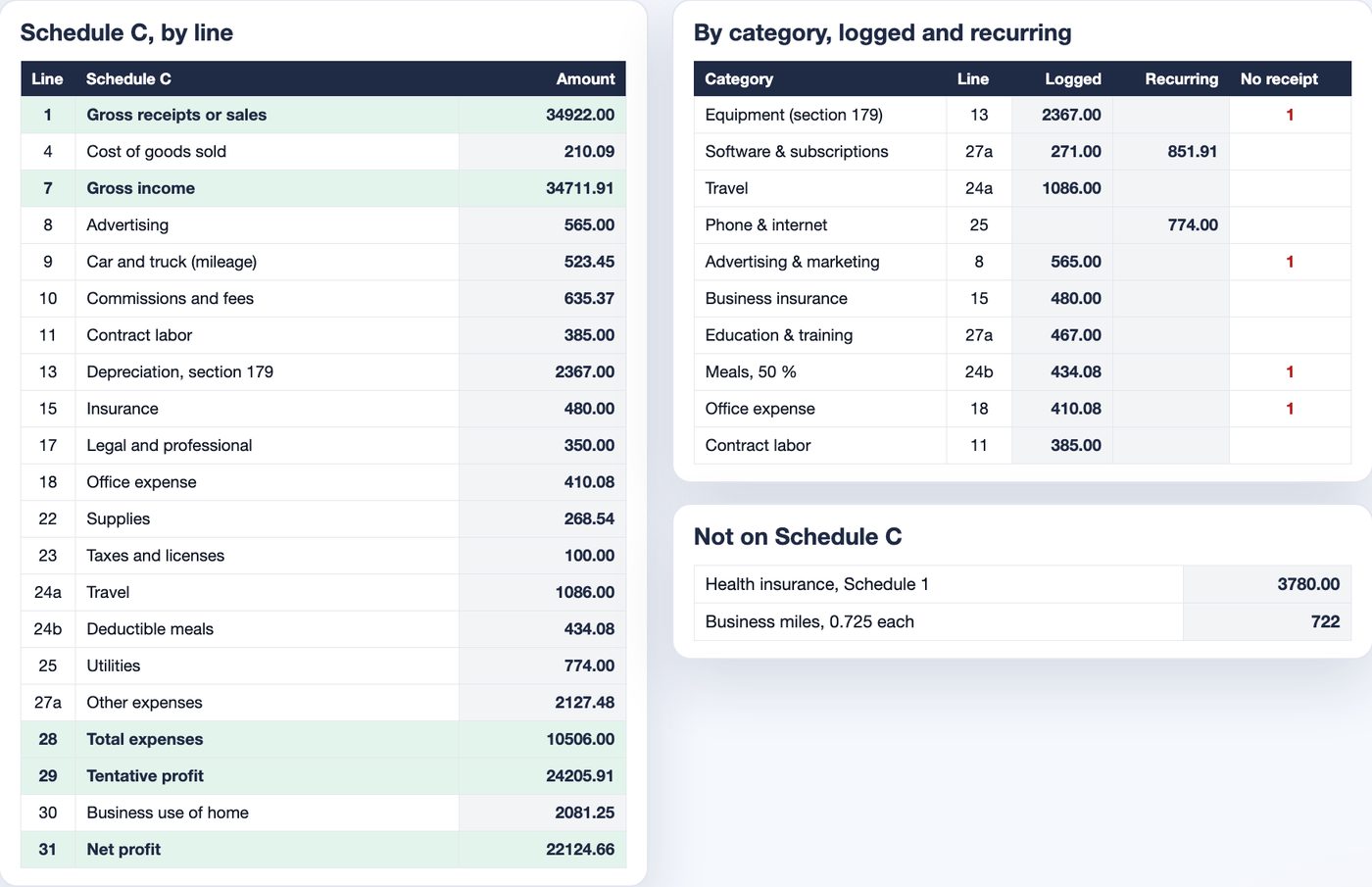
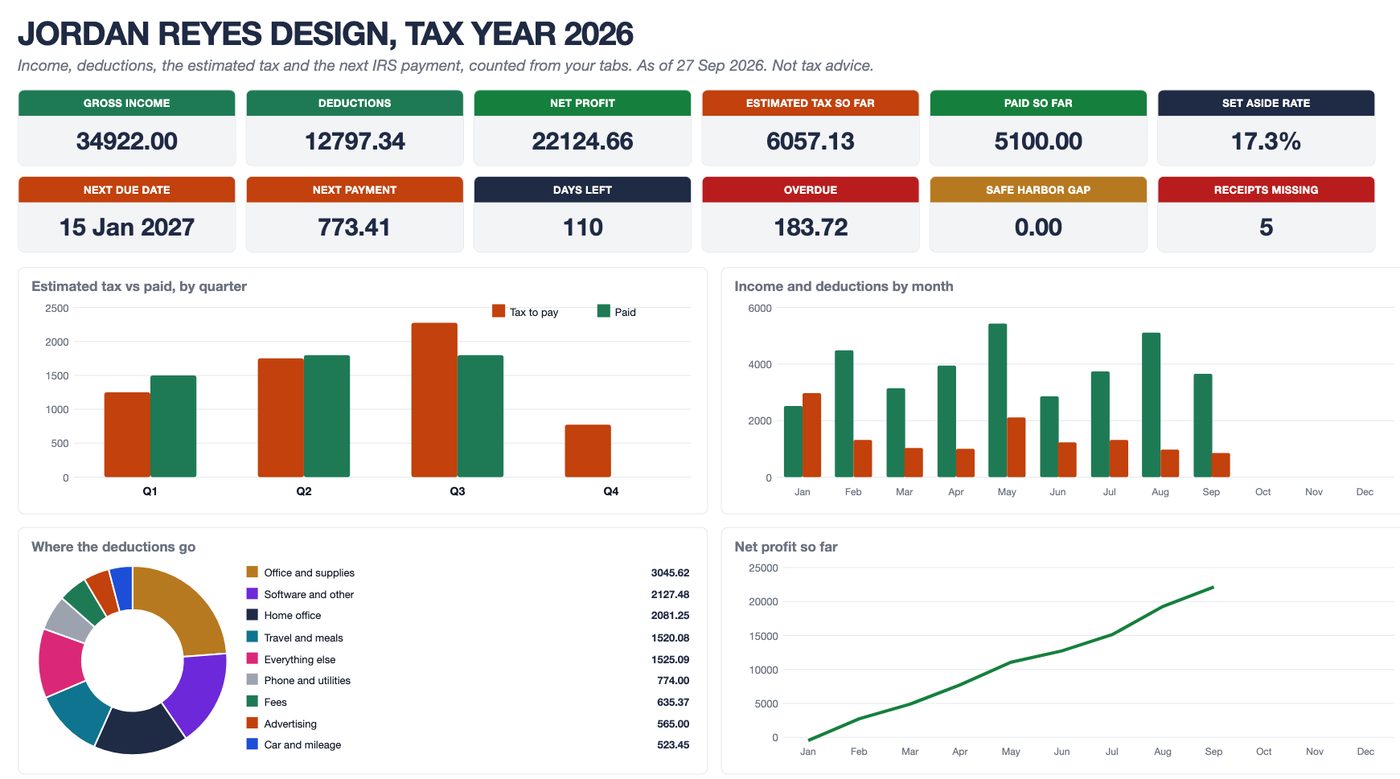
Everything above is in one file: Setup with your rates, Income, Deductions, Mileage, Home Office, Quarterly Tax, a Schedule C page that prints on one sheet for your tax pro, and a dashboard with 12 tiles. If you also track the household side, the annual budget for 2027 covers the other half of the year's money.
Tax Deduction Tracker for Google Sheets and Excel
For freelancers and 1099 sellers: log expenses, income and miles, and see write-offs by Schedule C line, the estimated tax so far and what to pay by each IRS due date. Lite (5 tabs) and Full (13 tabs), sample data and blank copies. Not tax advice: arithmetic on the rates you type.
Get the Tax Deduction Tracker on Etsy →FAQ
What should a tax deduction tracker include?
At minimum: date, who you paid, what for, a category that maps to a Schedule C line, the amount, the business percentage and a receipt link. Add your income with the platform fees taken out, business miles and the home office, otherwise you know your write-offs but not your profit or your tax. In the sample file that gives 34,922 income, 12,797.34 deductions and 22,124.66 net profit by 27 September.
How much does a deduction actually save in tax?
Less than the deduction itself. At the sample rates (15.3% self-employment tax on 92.35% of profit, 12% federal, 5% state) each extra 100 of deductions lowers the estimated tax by about 30.28. The 12,797.34 of deductions in the sample lower it by 3,875.29, from 9,932.42 to 6,057.13. Your rates will give a different number.
How do I calculate quarterly estimated tax in a spreadsheet?
Add up profit for the IRS periods so far (Jan-Mar, Apr-May, Jun-Aug, Sep-Dec), work out the tax on that profit, and subtract what the earlier quarters already counted. What you paid early or late carries over. In the sample, Q1 and Q2 were overpaid by 290.37 in total, so Q3 is 2,274.09 minus 1,800 minus 290.37, which leaves 183.72.
How much should I set aside from each payment?
Divide the estimated tax so far by the income so far. In the sample that is 6,057.13 / 34,922 = 17.3%, so a 1,800 retainer means 312.21 goes to a tax savings account the day it arrives. The rate moves as the year goes on, so let the sheet recalculate it rather than fixing a number in January.
Is a spreadsheet tax tracker tax advice?
No. It does arithmetic on the rates you type and does not file anything. Rates, the mileage rate, the wage base and due dates change every year: check irs.gov each January and ask a tax professional before you file or pay.
More from the blog
- How to Price Handmade Products: Materials, Labor, Fees and ProfitA worked pricing example for handmade products: an 8 oz soy candle that costs 11.29 to make needs 23.99 on Etsy for a 40% margin after fees. Formulas, a price ladder from 20% to 70%, fee comparison and break-even.
- Home Bakery Pricing: Cost Per Serving, Cake Quotes and Your MarginHow a home bakery spreadsheet prices a cake by servings: 36 servings at 7.50 each, 342.38 with tax, a 50% deposit, and 173.67 of profit on a 149.33 cost, plus a bake plan built from confirmed orders.
- Side Hustle Bookkeeping: Profit and Loss in One TabHow a small business bookkeeping spreadsheet turns 35 income rows and 40 expenses into a monthly profit and loss: 12758.50 in, 4405.39 out, 8353.11 profit, a 65.5% margin and a quarterly tax set-aside.
- Subscription Tracker: What Your Subscriptions Cost Per YearWhat a subscription tracker spreadsheet shows for a list of 24 subscriptions: 310.32 a month and 3,723.87 a year once yearly, quarterly and weekly plans are normalized, 6 charges due in the next 7 days, a trial ending, and 5 unused subscriptions worth 875.63 a year.