 HeyPlanly
ADHD Budget Planner: Fewer Categories and One Number a Day
Most budgets ask you to hold a monthly table in your head and divide it at the till: how much of the grocery line is left, how many days are left, is this coffee fine. For a lot of people with ADHD that is the step that fails, and once a tracker has been skipped for a week it is hard to go back. This article walks through a budget built the other way round: you type what you spend, and you look at one number, safe to spend today.
The sample month: 3,480 in, one number out
The sample file is set to September 2026, and "today" is the 17th, day 17 of 30. Income is three rows: two paychecks of 1,520 on the 4th and the 18th and a side gig of 440. There are 8 bills, from rent of 1,150 to streaming at 18, and 3 sinking funds that take 195 a month. The Spending log has 34 rows from 1 to 17 September.
| Step | Amount | Where it comes from |
|---|---|---|
| Income this month | 3,480.00 | 1,520 + 1,520 + 440 |
| Bills this month | - 1,590.00 | 8 bills on the Bills tab |
| Into sinking funds | - 195.00 | car 100, Christmas 70, vet 25 |
| Money for spending | 1,695.00 | what the month can actually spend |
| Spent this month | 990.40 | 34 rows, 1 to 17 Sep |
| Left this month | 704.60 | 1,695 - 990.40 |
| Safe per day | 50.33 | 704.60 / 14 days left |
| Safe to spend today | 34.22 | see the formula below |
Everything except the bottom line is there for checking. The tile you look at on your phone before you pay is the last one.
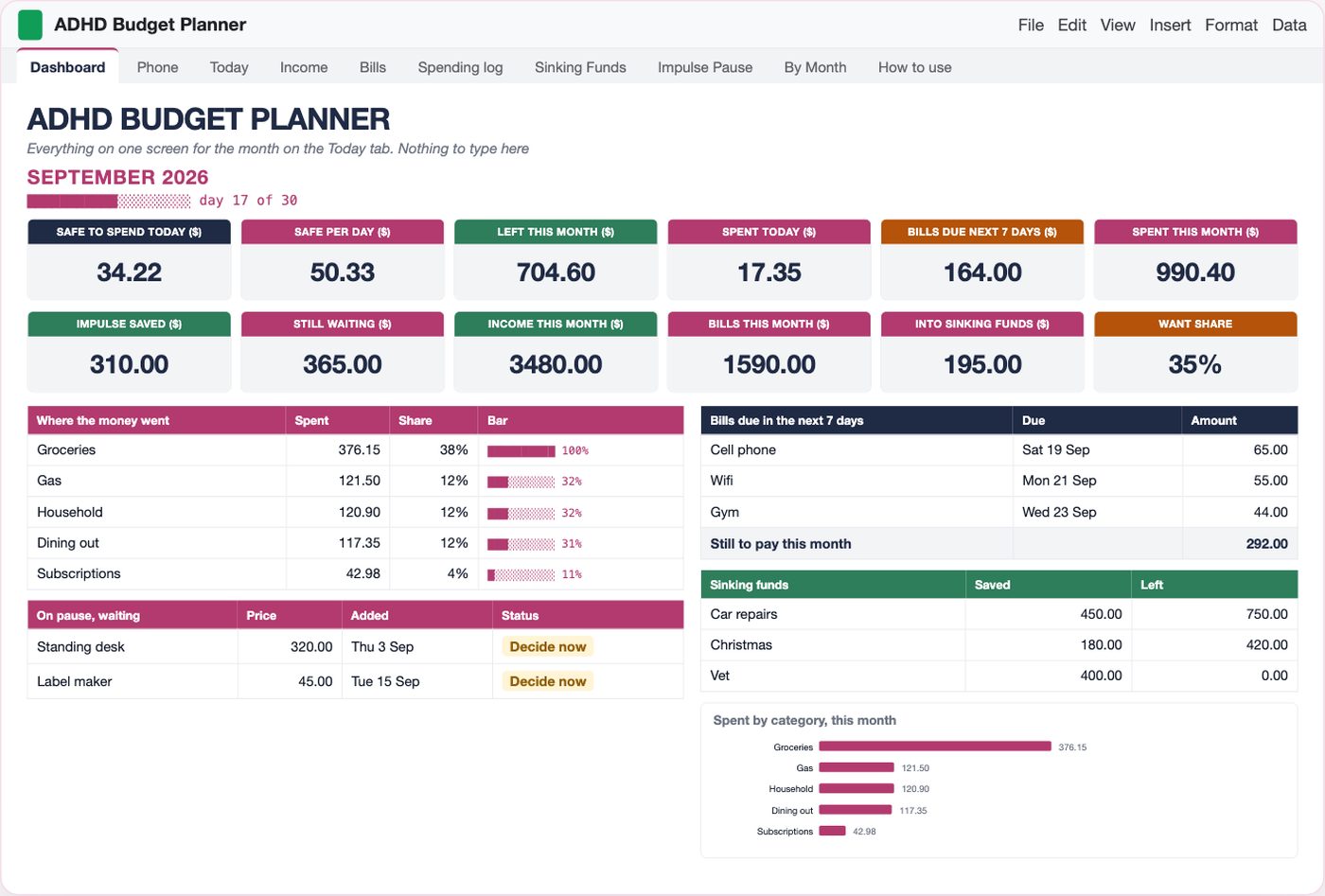
Safe to spend today, worked out
On the 1st of the month the daily amount is simple: 1,695 / 30 = 56.50. By the 17th the sample had spent 973.05 before today, against 16 x 56.50 = 904.00 on plan, so it is 69.05 ahead of plan. Spread over the 14 days that are left, that is 4.93 a day less: 56.50 - 4.93 = 51.57. Today already has a 4.85 latte and 12.50 of cat litter, 17.35 in total, so what is still safe today is 51.57 - 17.35 = 34.22.
In the file that is one formula on the Today tab, where I20 is money for spending, I21 spent this month, I22 spent today and I17 the days left including today:
=(I20 - (I21 - I22)) / I17 - I22
On the sample: (1,695 - (990.40 - 17.35)) / 14 - 17.35 = 34.22. The days left are the days in the month minus today's day number plus one:
=DAY(EOMONTH(I6, 0)) - DAY(I15) + 1
I6 is the 1st of the month you typed, I15 is today. 30 - 17 + 1 = 14. The point of subtracting yesterday's spending inside the division, and today's outside it, is that a bad day only hurts that day. Overspend by 20 today and tomorrow's number drops by about 1.54 (20 spread over 13 days), not by 20.
There is also a "before you buy" row. In the sample someone is looking at clothes for 68. The file answers: 34.22 - 68 = -33.78 today, 704.60 - 68 = 636.60 for the month, so the verdict reads "Not today. It still fits this month." Nothing is logged by that row.
Fewer categories, and where the money went
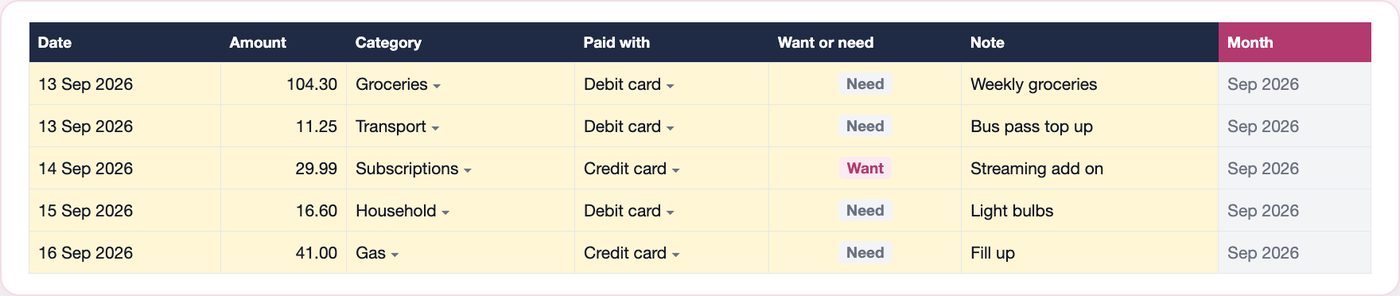
The log has six columns: date, amount, category, paid with, want or need, note. The category list is 20 yellow cells you rename, and the sample uses 13 of them. Five categories hold almost 79% of the month:
| Category | Rows | Spent | Share |
|---|---|---|---|
| Groceries | 6 | 376.15 | 38% |
| Gas | 3 | 121.50 | 12% |
| Household | 3 | 120.90 | 12% |
| Dining out | 4 | 117.35 | 12% |
| Subscriptions | 2 | 42.98 | 4% |
| 8 other categories | 16 | 211.52 | 21% |
| Total | 34 | 990.40 | 100% |
Coffee is the classic small leak: 6 rows, 31.00 by the 17th, never more than 6.40 at a time. It does not need its own budget line, it only needs to be logged, because it is already inside the 990.40 that the daily number uses. A category total, if you want one, is a SUMIFS on the date range of the month:
=SUMIFS(B6:B1005, A6:A1005, ">="&DATE(2026,9,1),
        A6:A1005, "<="&EOMONTH(DATE(2026,9,1),0), C6:C1005, "Groceries")
That returns 376.15 on the sample. Because it matches on the date, rows typed late and out of order still land in the right month. The want or need column adds up the same way: 639.09 of needs and 351.31 of wants, a want share of 35.5% of tracked spending. Measured against income, the wants are 351.31 / 3,480 = 10.1%, well under the 30% that the 50/30/20 budget allows.
The 48 hour impulse pause
The thing you want right now goes on a list instead of into the basket: what it is, the price, the date. Two days later the status turns to Decide now, and you pick Bought or Skipped.
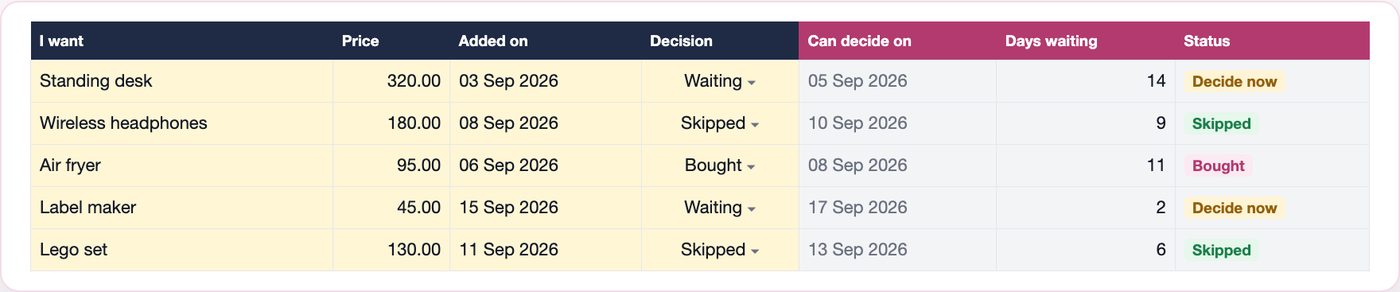
The status is one IF chain, with D the date added and F the decision:
=IF(F6="Bought", "Bought", IF(F6="Skipped", "Skipped",
   IF(TODAY() >= D6 + 2, "Decide now", "Still waiting")))
And what the pause kept is a SUMIF on the decision column:
=SUMIF(F6:F25, "Skipped", C6:C25)
In the sample: headphones at 180 and a Lego set at 130 were skipped, 310 in total. The air fryer, 95, was bought after the pause and is logged on the Spending log like any other purchase. The standing desk (320) and the label maker (45) are waiting, 365 together. Note that the desk has been "Decide now" for 12 days: the pause does not decide for you, it only makes sure the decision is not made at 11 pm.
Bills and sinking funds come out first
All 8 bills, 1,590, leave the spending money on the 1st, whether they are paid or not. By the 17th, 1,298 is paid and 292 is still to come; 164 of that is due in the next 7 days (phone 65 on the 19th, wifi 55 on the 21st, gym 44 on the 23rd), and the car insurance of 128 is on the 27th. Because the bills were never part of the 1,695, paying them does not move the daily number. If you want the due dates on a calendar, the bill calendar article covers that side.
| Sinking fund | Target | Saved | Per month | Months to go | Full by |
|---|---|---|---|---|---|
| Car repairs | 1,200 | 450 | 100 | 8 | May 2027 |
| Christmas | 600 | 180 | 70 | 6 | Mar 2027 |
| Vet | 400 | 400 | 25 | 0 | full |
The table shows a real problem with the sample: at 70 a month the Christmas fund is full in March 2027, three months after Christmas. To fill the remaining 420 over October, November and December takes 140 a month. Typing 140 instead of 70 takes another 70 out of spending money, so 1,695 becomes 1,625, left this month becomes 634.60 and safe per day drops from 50.33 to 45.33. Less money per day, but no surprise in December.
Skip the setup
Everything above is in one file: Today with the daily number and the before you buy row, a Spending log of 1,000 rows, Bills, Income, Sinking Funds, the Impulse Pause, a By Month view of the year, a Phone tab and the Dashboard. There is also a Lite file with only Today, Spending log, Bills and Dashboard, for the months when 10 tabs is too many. If your income comes every two weeks, the biweekly paycheck budget explains how to handle the three-paycheck months.
ADHD Budget Planner for Google Sheets and Excel
One number a day: safe to spend today. Type what you spend, the file spreads what is left over the days that are left, with a 48 hour impulse pause, bills and sinking funds. Lite (5 tabs) and Full (10 tabs), sample data and blank copies, undated, any currency.
Get the ADHD Budget Planner on Etsy →FAQ
What is the best budget method for ADHD?
One that asks you to look at a single number instead of a monthly table. Take income, subtract the bills and what goes into sinking funds, spread what is left over the days left in the month and subtract what you already spent today. In the sample month that is 3,480 - 1,590 - 195 = 1,695 to spend, and on day 17 the number is 34.22. It is not medical or financial advice, it is arithmetic you do not have to do at the till.
How do you calculate safe to spend today?
Money for spending minus what you spent before today, divided by the days left including today, minus what you spent today. In the sample: (1,695 - 973.05) / 14 - 17.35 = 34.22. If it goes below zero, today is over budget, but tomorrow starts again from the same formula.
What if I stop logging for a week?
Type the purchases you remember with their real dates, in any order. Spent this month is a SUMIFS on the date, so late rows land in the right month and the daily number corrects itself. There is no streak to lose and nothing to reset.
How does a 48 hour impulse pause work in a spreadsheet?
Each thing you want goes on a list with the price and the date. The decide-on date is that date plus 2, and a status formula shows Decide now once today reaches it. You mark Bought or Skipped, and a SUMIF adds up the skipped prices. In the sample 2 skipped items kept 310, 1 was bought for 95 and 2 are still waiting at 365.
Why take bills out for the whole month?
So the daily number does not jump on the day a bill is paid. In the sample 1,298 of bills are paid and 292 are still to come, but all 1,590 are already outside the spending money. Paying the 128 car insurance on the 27th changes nothing about what is safe to spend that day.
More from the blog
- How to Price Handmade Products: Materials, Labor, Fees and ProfitA worked pricing example for handmade products: an 8 oz soy candle that costs 11.29 to make needs 23.99 on Etsy for a 40% margin after fees. Formulas, a price ladder from 20% to 70%, fee comparison and break-even.
- Home Bakery Pricing: Cost Per Serving, Cake Quotes and Your MarginHow a home bakery spreadsheet prices a cake by servings: 36 servings at 7.50 each, 342.38 with tax, a 50% deposit, and 173.67 of profit on a 149.33 cost, plus a bake plan built from confirmed orders.
- Side Hustle Bookkeeping: Profit and Loss in One TabHow a small business bookkeeping spreadsheet turns 35 income rows and 40 expenses into a monthly profit and loss: 12758.50 in, 4405.39 out, 8353.11 profit, a 65.5% margin and a quarterly tax set-aside.
- Subscription Tracker: What Your Subscriptions Cost Per YearWhat a subscription tracker spreadsheet shows for a list of 24 subscriptions: 310.32 a month and 3,723.87 a year once yearly, quarterly and weekly plans are normalized, 6 charges due in the next 7 days, a trial ending, and 5 unused subscriptions worth 875.63 a year.