 HeyPlanly
Christmas Savings Challenge: How Much to Save Each Week Until December 25
Christmas 2026 falls on a Friday, and twelve weeks before it is Friday, October 2. A Christmas savings challenge is nothing more than a schedule for those twelve weeks: a goal, twelve amounts that add up to it, and a box to colour each time the money goes into the envelope. Below are the actual schedules for six goals from 360 to 2,000, with the dates, a comparison with saving the same amount every week, and the formulas to build the table in Google Sheets.
Pick the goal first
The weekly amount follows from the total, so start there. Add up gifts, food, decorations, travel, cards and postage, then pick the schedule closest to that number. If you do not have a total yet, the Christmas budget walkthrough shows how to set a limit per person and per category first.
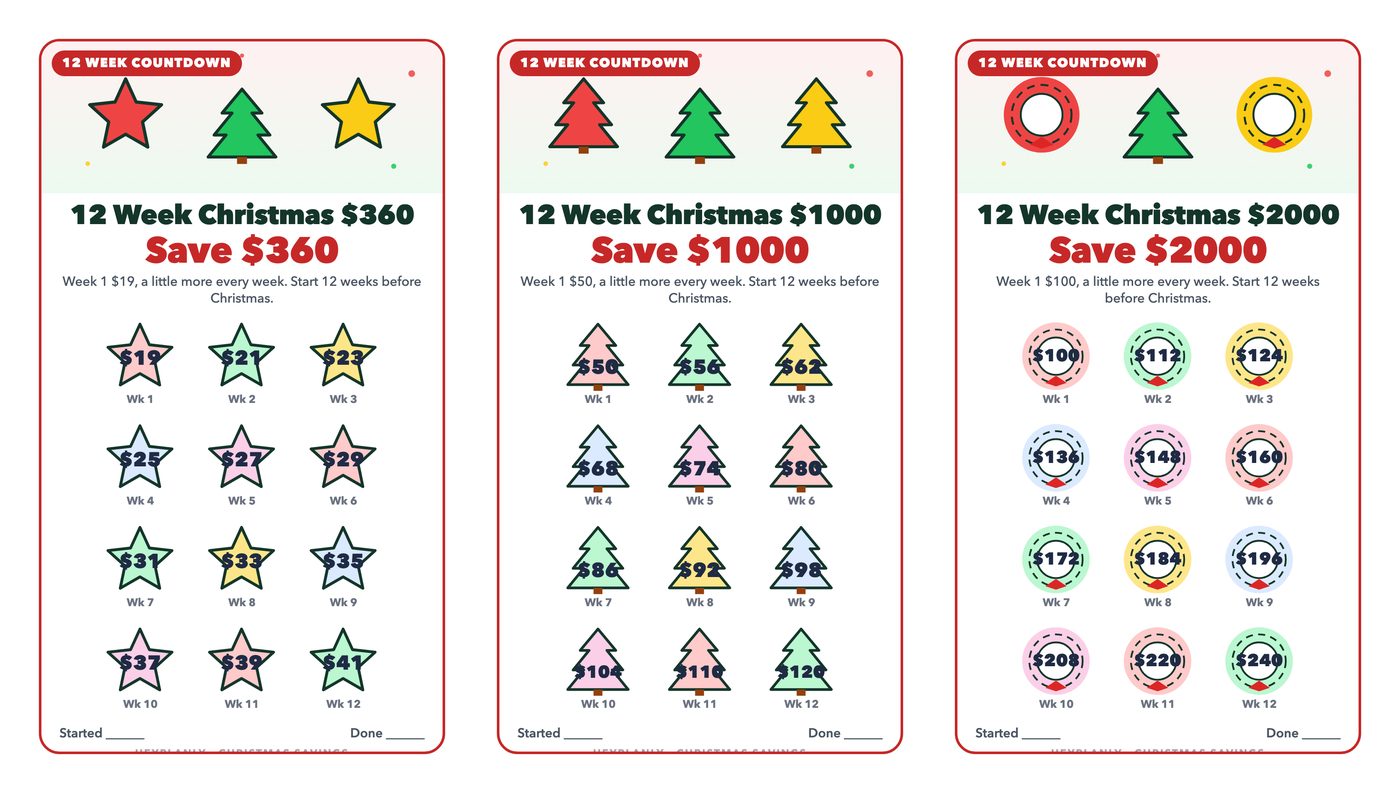
These six schedules come from a printable 12 week countdown. Each one starts with a small week 1 and grows by a fixed step, and the last week takes whatever is left so the column adds up to the dollar.
| Goal | Week 1 | Weekly step | Week 12 | Same every week | Per day (84 days) |
|---|---|---|---|---|---|
| 360 | 19 | +2 | 41 | 30.00 | 4.29 |
| 480 | 18 | +4 | 62 | 40.00 | 5.71 |
| 750 | 35 | +5 | 90 | 62.50 | 8.93 |
| 1,000 | 50 | +6 | 120 | 83.33 | 11.90 |
| 1,500 | 70 | +10 | 180 | 125.00 | 17.86 |
| 2,000 | 100 | +12 | 240 | 166.67 | 23.81 |
The last two columns are the same goal divided evenly: by 12 weeks and by the 84 days between October 2 and December 25. They are useful as a sanity check. If 11.90 a day sounds impossible, the 1,000 goal is too high for this year, whatever the schedule looks like.
The 12 weeks, with dates
Week 1 is the Friday twelve weeks before Christmas, week 12 is the Friday one week before it. For 2026:
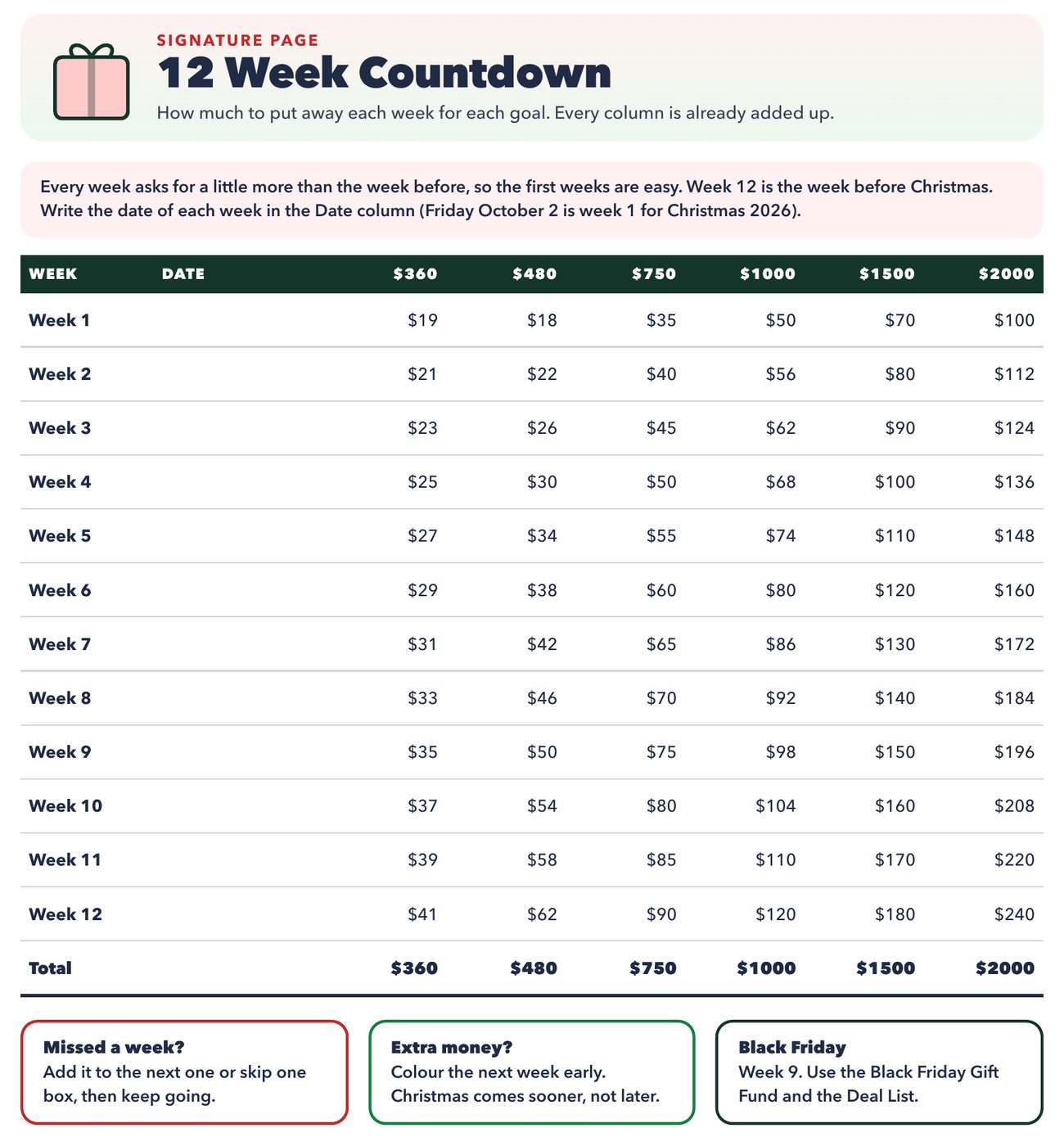
| Week | Friday | 360 | 480 | 750 | 1,000 | 1,500 | 2,000 |
|---|---|---|---|---|---|---|---|
| 1 | Oct 2 | 19 | 18 | 35 | 50 | 70 | 100 |
| 2 | Oct 9 | 21 | 22 | 40 | 56 | 80 | 112 |
| 3 | Oct 16 | 23 | 26 | 45 | 62 | 90 | 124 |
| 4 | Oct 23 | 25 | 30 | 50 | 68 | 100 | 136 |
| 5 | Oct 30 | 27 | 34 | 55 | 74 | 110 | 148 |
| 6 | Nov 6 | 29 | 38 | 60 | 80 | 120 | 160 |
| 7 | Nov 13 | 31 | 42 | 65 | 86 | 130 | 172 |
| 8 | Nov 20 | 33 | 46 | 70 | 92 | 140 | 184 |
| 9 | Nov 27 (Black Friday) | 35 | 50 | 75 | 98 | 150 | 196 |
| 10 | Dec 4 | 37 | 54 | 80 | 104 | 160 | 208 |
| 11 | Dec 11 | 39 | 58 | 85 | 110 | 170 | 220 |
| 12 | Dec 18 | 41 | 62 | 90 | 120 | 180 | 240 |
| Total | 360 | 480 | 750 | 1,000 | 1,500 | 2,000 |
If your payday is not a Friday, shift every date by the same number of days. The amounts do not change.
Rising or flat: what you have by Black Friday
A rising schedule is popular because week 1 is easy: 50 instead of 83.33 on the 1,000 goal. The cost is at the other end. Week 12 is 120, 2.4 times week 1, and it lands in the most expensive week of the year. Here is how the two approaches compare along the way:
| After week | Rising (50 to 120) | Flat (83.33) | Difference |
|---|---|---|---|
| 4 (Oct 23) | 236 | 333.33 | -97.33 |
| 6 (Nov 6) | 390 | 500.00 | -110.00 |
| 8 (Nov 20) | 568 | 666.67 | -98.67 |
| 9 (Nov 27) | 666 | 750.00 | -84.00 |
| 12 (Dec 18) | 1,000 | 1,000.00 | 0.00 |
The first six weeks of the rising schedule add up to 390, the last six to 610. On the morning of Black Friday, with eight boxes coloured, you have 568; flat saving would have put 666.67 in the envelope by then. So the choice depends on when you shop. If most of the spending happens in December, rising works well. If you buy early or on Black Friday, either save flat or keep a separate Black Friday fund next to the countdown. The printable has three of those: 200 (twenty 10s), 350 (twenty five 10s and five 20s) and 550 (thirty five 10s and ten 20s).
Build the schedule in Google Sheets
You can make your own version for any goal. Put the inputs in four cells: the goal in B1, the week 1 amount in B2, the weekly step in B3 and Christmas Day in B4 as =DATE(2026,12,25). Then number the weeks 1 to 12 in A7:A18 and add three formulas:
Date of the week (B7, copy down to B18):
=$B$4-7*(13-A7)

Amount for weeks 1 to 11 (C7, copy down to C17):
=$B$2+$B$3*(A7-1)

Amount for week 12 (C18):
=$B$1-SUM(C7:C17)
With 1,000, 50 and 6 in B1:B3 this returns October 2 for week 1, 50, 56, 62 and so on up to 110 for week 11, and 120 for week 12, the same as the table above. Week 12 is calculated as the remainder on purpose: weeks 1 to 11 add up to 880, and whatever step you choose, the last week closes the gap to the goal. If week 12 comes out smaller than week 11, the step is too big for that goal; lower it.
Insert checkboxes in D7:D18 (Insert, Checkbox) and tick one each time you put the money away. Two more formulas show where you stand:
Saved so far:
=SUMIF(D7:D18, TRUE, C7:C18)

Flat amount per week from today to reach the goal:
=IF(INT(($B$4-TODAY())/7)<1, "",
  ROUNDUP(($B$1-SUMIF(D7:D18, TRUE, C7:C18)) / INT(($B$4-TODAY())/7), 0))
The second one counts the full weeks left until Christmas and spreads what is still missing over them. It is the number to look at if you start late.
Paid every two weeks, or starting late
Biweekly pay. Colour two weeks per payday. The 1,000 schedule becomes six deposits: 106, 130, 154, 178, 202 and 230. The 360 schedule becomes 40, 48, 56, 64, 72 and 80. If your first payday is October 2, the last deposit is December 11 and the fund is complete two weeks before Christmas. The biweekly paycheck budget shows how to fit a deposit like that between the bills each paycheck already has to cover.
Starting late. Say you begin on October 23, which is week 4. Three boxes of the 1,000 schedule are empty: 50 + 56 + 62 = 168. There are three ways out:
- Double up: colour two boxes per payday for three paydays (106 on October 23, 130 on October 30, 154 on November 6). From November 13 you are back on the normal schedule.
- Go flat: 9 weeks are left, 1,000 / 9 = 111.11, so 112 a week. That is what the formula above returns on October 23.
- Pick a smaller goal: weeks 4 to 12 of the 750 schedule add up to 630, with no catching up at all.
A missed week in the middle works the same way: add it to the next one, or leave one box empty and accept a total that is one week short.
Spend it by the week too
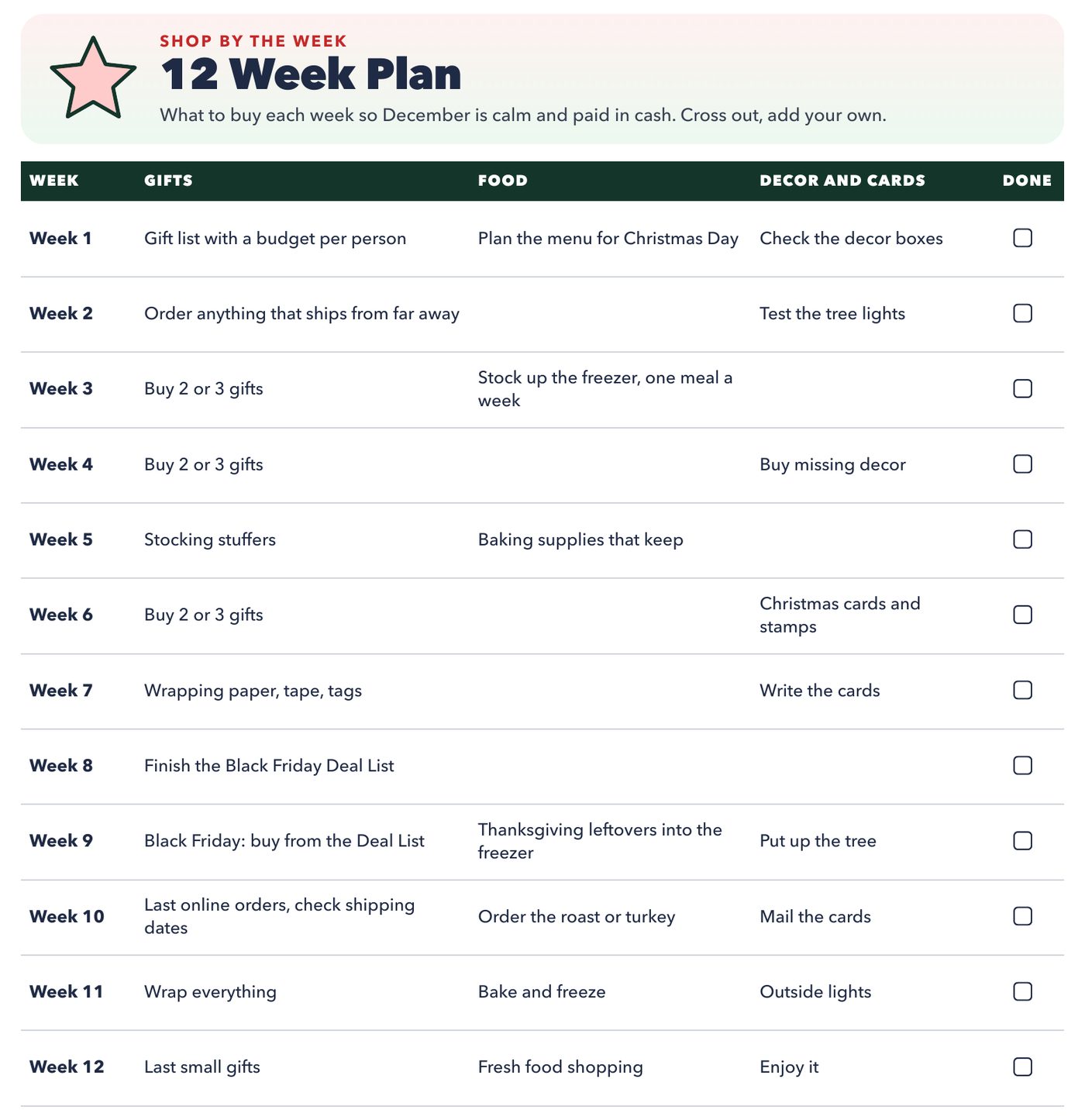
Saving for twelve weeks and then buying everything in the last one brings back the December crunch the fund was meant to remove. The countdown is easier to keep when the shopping is spread over the same weeks: the gift list and the menu in week 1, a few gifts in weeks 3, 4 and 6, cards and stamps in week 6, the Black Friday list finished in week 8, last online orders in week 10.
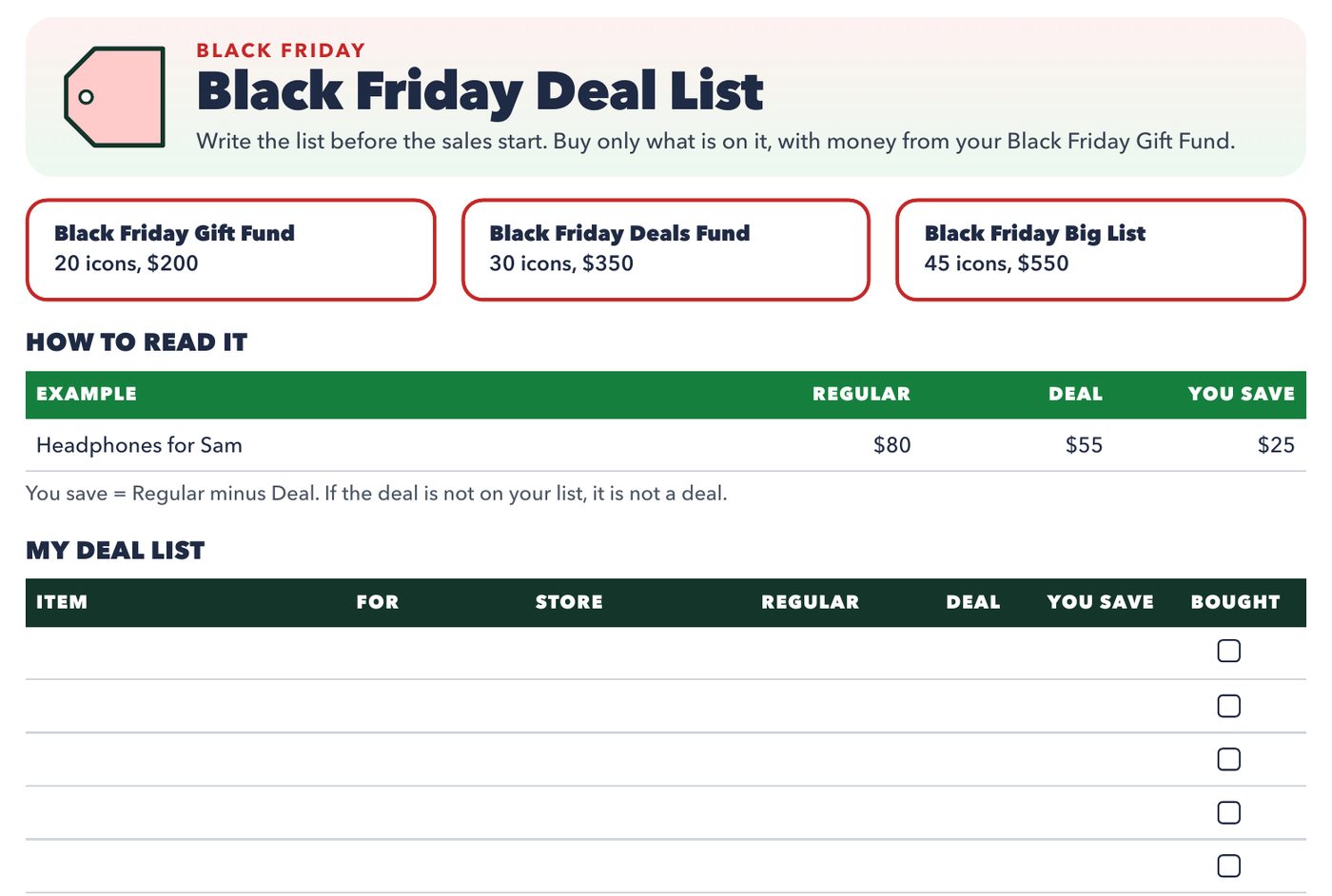
For Black Friday itself, write the list before the sales start, with the regular price next to the deal price. An 80 pair of headphones at 55 saves 25, but only if the headphones were on the list.
If you like the colour-a-box format and want one that runs all year, the 100 envelope and 52 week challenges work on the same idea with bigger totals.
The printable version
Everything above fits on paper: the six countdown schedules as cards, the table with a Date column to fill in, and the week by week shopping plan.
Christmas Savings Challenge Printable, 12 Week Countdown
33 savings cards, 3.5 x 6 in: six 12 week countdowns from 360 to 2,000, 19 mini challenges from 24 to 320, three Black Friday funds, four games and a blank card. Plus a 14 page planner with the Christmas Budget, 12 Week Plan, a Gift List for 25 people and the Black Friday Deal List. PDF, US Letter and A4; the A4 cards have no currency sign.
Get the Christmas Savings Kit on Etsy →FAQ
How much should I save each week for Christmas?
Divide your Christmas total by the weeks you have left. Over 12 weeks, 1,000 is 83.33 a week flat, 750 is 62.50 and 360 is 30. A rising schedule starts lower and ends higher: for 1,000 it is 50 in week 1, 6 more every week, and 120 in week 12.
When should I start a 12 week Christmas savings challenge?
Twelve weeks before December 25. For Christmas 2026 that is Friday, October 2. Week 9 is Friday, November 27, which is Black Friday, and week 12 is Friday, December 18, one week before Christmas Day.
Is it too late to start saving for Christmas?
No. If you start on October 23, three weeks late, you have 9 weeks left. For 1,000 you can save a flat 112 a week, or colour two boxes per payday for three paydays (106, 130 and 154) and be back on schedule by November 6. Or drop to a smaller goal: weeks 4 to 12 of the 750 schedule add up to 630.
Is it better to save the same amount every week or a rising amount?
A rising amount is easier to start and harder to finish. On the 1,000 schedule the first six weeks add up to 390 and the last six to 610. A flat 83.33 a week has 500 saved by the halfway point. If you plan to shop early or on Black Friday, flat saving or a separate Black Friday fund puts more cash in hand sooner.
How do I do the challenge if I am paid every two weeks?
Colour two weeks per payday. On the 1,000 schedule the six paydays are 106, 130, 154, 178, 202 and 230, which add up to 1,000. On the 360 schedule they are 40, 48, 56, 64, 72 and 80.
More from the blog
- How to Price Handmade Products: Materials, Labor, Fees and ProfitA worked pricing example for handmade products: an 8 oz soy candle that costs 11.29 to make needs 23.99 on Etsy for a 40% margin after fees. Formulas, a price ladder from 20% to 70%, fee comparison and break-even.
- Home Bakery Pricing: Cost Per Serving, Cake Quotes and Your MarginHow a home bakery spreadsheet prices a cake by servings: 36 servings at 7.50 each, 342.38 with tax, a 50% deposit, and 173.67 of profit on a 149.33 cost, plus a bake plan built from confirmed orders.
- Side Hustle Bookkeeping: Profit and Loss in One TabHow a small business bookkeeping spreadsheet turns 35 income rows and 40 expenses into a monthly profit and loss: 12758.50 in, 4405.39 out, 8353.11 profit, a 65.5% margin and a quarterly tax set-aside.
- Subscription Tracker: What Your Subscriptions Cost Per YearWhat a subscription tracker spreadsheet shows for a list of 24 subscriptions: 310.32 a month and 3,723.87 a year once yearly, quarterly and weekly plans are normalized, 6 charges due in the next 7 days, a trial ending, and 5 unused subscriptions worth 875.63 a year.